
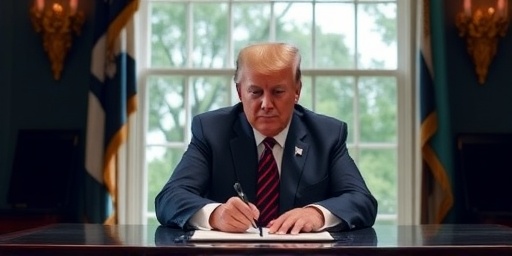
In a bold move to cement the United States’ dominance in the global technology race, President Donald Trump has signed a sweeping executive order on Artificial intelligence, directing federal agencies to prioritize AI research, development, and ethical deployment. The order, unveiled during a White House ceremony on Monday, aims to inject billions into AI initiatives while establishing robust guidelines to ensure safe and innovative use across government sectors.
This executive order comes at a critical juncture, as nations like China ramp up their own AI investments, threatening America’s technological edge. Trump emphasized the order’s role in fostering job creation and national security, stating, ‘Artificial intelligence isn’t just the future—it’s our competitive advantage right now. We’re unleashing American ingenuity to lead the world in this technology revolution.’
Core Directives Shaping Federal AI Strategy
The executive order outlines a comprehensive framework for Artificial intelligence integration into federal policy, mandating that all executive departments incorporate AI strategies into their operations within the next two years. Key among these directives is the creation of an AI Task Force, led by the White House Office of Science and Technology Policy, to oversee implementation and report progress quarterly to the President.
One standout provision requires federal agencies to identify and automate routine tasks using AI, potentially saving taxpayers up to $10 billion annually through efficiency gains, according to preliminary estimates from the Office of Management and Budget. This includes deploying AI-driven analytics in areas like cybersecurity and predictive maintenance for infrastructure. The order also emphasizes ethical AI use, prohibiting discriminatory algorithms and mandating bias audits for all government AI systems.
Trump’s directive extends to public-private partnerships, encouraging collaboration between federal entities and tech giants like Google, Microsoft, and IBM. ‘We’re not just talking policy; we’re funding breakthroughs,’ Trump remarked, highlighting how the order aligns with his broader agenda to revitalize American manufacturing through smart technology.
To address workforce impacts, the order allocates resources for AI literacy programs in federal training, ensuring employees are equipped for an AI-augmented workplace. Statistics from the Department of Labor project that AI could displace 2 million jobs by 2030 but create 3.5 million new ones in high-tech fields, underscoring the need for proactive federal policy.
Funding Surge Targets AI Research and Development
A cornerstone of the executive order is the redirection of federal funding toward artificial intelligence research, with an initial $2 billion infusion from the National Science Foundation and the Department of Energy. This funding will support cutting-edge projects in machine learning, quantum computing integration with AI, and autonomous systems for defense and healthcare.
The Department of Defense, a major beneficiary, will receive $500 million to advance AI in military applications, such as enhanced drone surveillance and real-time battlefield decision-making. Pentagon officials have praised the move, noting it could reduce operational costs by 20% while improving mission success rates. ‘This executive order positions the U.S. military as the undisputed leader in AI-driven warfare,’ said Defense Secretary Lloyd Austin in a prepared statement.
In the civilian sector, the order prioritizes AI for healthcare, directing the National Institutes of Health to fund AI tools for drug discovery and personalized medicine. Early trials suggest AI could accelerate vaccine development timelines by 50%, a lesson learned from the COVID-19 pandemic. Additionally, the Department of Transportation will invest in AI for smart traffic systems, aiming to cut urban congestion by 15% in major cities like New York and Los Angeles.
Critics, however, question the funding’s allocation, with some Democrats arguing it favors defense over social programs. Rep. Alexandria Ocasio-Cortez tweeted, ‘Trump’s AI push is heavy on bombs and light on people—where’s the funding for AI in education equity?’ Despite partisan divides, the order’s technology focus has garnered bipartisan support from industry leaders, who see it as a catalyst for innovation.
The funding mechanism includes tax incentives for AI startups, potentially spurring a wave of entrepreneurship. Venture capital firms report a 30% uptick in AI investments since rumors of the executive order surfaced, signaling market confidence in Trump’s federal policy vision.
Navigating Ethical and Security Challenges in AI Deployment
While championing artificial intelligence, the executive order places strong safeguards against misuse, mandating cybersecurity standards for all AI systems deployed by federal agencies. This includes requirements for ‘explainable AI,’ where algorithms must provide transparent reasoning for decisions, particularly in sensitive areas like law enforcement and financial regulation.
The Federal Trade Commission will enforce new rules on AI data privacy, building on existing GDPR-inspired frameworks to protect citizen information. A recent Pew Research Center survey found 64% of Americans concerned about AI privacy risks, making these provisions timely. The order also bans federal use of facial recognition AI in immigration enforcement without congressional oversight, addressing civil liberties groups’ fears of overreach.
On the international front, Trump’s executive order signals a tougher stance on technology competition. It directs the State Department to negotiate AI export controls with allies, aiming to curb technology transfers to adversarial nations. Experts estimate this could safeguard U.S. intellectual property worth $100 billion annually. ‘We’re drawing a line in the sand—America’s AI leads the world, and we’ll keep it that way,’ Trump declared.
Security enhancements extend to critical infrastructure, with the Department of Homeland Security tasked to integrate AI for threat detection in power grids and transportation networks. Simulations show AI could prevent 70% of cyber attacks that currently cost the economy $200 billion yearly.
Environmental considerations are woven in, requiring AI projects to minimize carbon footprints through efficient computing. The order aligns with Trump’s energy independence goals, promoting AI-optimized renewable energy grids to achieve net-zero emissions in federal buildings by 2035.
Industry Leaders and Experts Praise Trump’s AI Vision
The technology sector has overwhelmingly welcomed the executive order, with Silicon Valley executives hailing it as a pivotal step for American innovation. Elon Musk, CEO of Tesla and SpaceX, tweeted, ‘This federal policy on artificial intelligence will supercharge U.S. tech leadership—kudos to President Trump for prioritizing AI deployment.’
Sundar Pichai, Google’s CEO, echoed this sentiment in a blog post: ‘The executive order provides the clarity and resources needed to responsibly advance AI, benefiting both industry and society.’ Industry analysts from Gartner predict the order could boost U.S. AI market growth to $500 billion by 2025, up from $100 billion in 2020.
Academic experts are equally optimistic. Dr. Fei-Fei Li, a Stanford AI pioneer, stated in an interview, ‘Trump’s focus on ethical guidelines and funding is a game-changer. It addresses the talent shortage by committing to education initiatives, potentially training 1 million AI specialists over the next decade.’
However, not all reactions are glowing. AI ethicist Timnit Gebru warned of potential biases in implementation, saying, ‘Without diverse voices in the AI Task Force, this executive order risks perpetuating inequalities.’ The White House has promised inclusive representation, including appointments from underrepresented communities in tech.
Labor unions, while supportive of job training, urge stronger protections against AI-driven automation in manufacturing. The AFL-CIO’s president noted, ‘This technology boom must include workers, not leave them behind.’ Trump’s administration has responded by pledging $300 million for reskilling programs tailored to AI-impacted sectors.
Charting the Path Forward for U.S. AI Supremacy
Looking ahead, the executive order sets ambitious milestones, including a national AI strategy report due by mid-2024 that will outline long-term federal policy goals. This roadmap envisions AI as a driver for economic recovery, with projections of adding 5% to GDP growth through enhanced productivity.
International implications are profound; the order positions the U.S. to lead global AI standards, potentially influencing treaties at forums like the G7 and UN. Allies such as the UK and EU have expressed interest in aligning their policies, fostering a united Western front against non-democratic AI advances.
Domestically, the order’s success hinges on congressional buy-in for sustained funding. With midterm elections looming, AI could become a flashpoint issue, as both parties vie to claim credit for technology progress. Bipartisan bills already in committee suggest momentum for legislative complements to Trump’s initiative.
For everyday Americans, the ripple effects promise smarter services—from AI-assisted virtual healthcare consultations to optimized disaster response systems. As implementation unfolds, monitoring bodies will track metrics like innovation patents (aiming for a 40% increase) and ethical compliance rates.
Ultimately, this executive order under Trump marks a strategic pivot, transforming artificial intelligence from a buzzword into a cornerstone of federal policy. By balancing innovation with responsibility, the U.S. is poised to not just participate in the AI era, but define it, ensuring technology serves as a force for prosperity and security in the years to come.