

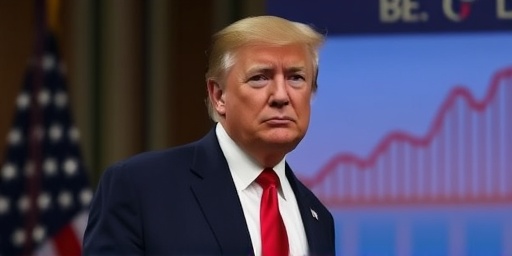
In a move that’s sending shockwaves through financial markets and economic circles, the Trump administration has officially canceled the release of the advance estimate for the third-quarter GDP report. The Bureau of Economic Analysis (BEA), the federal agency responsible for compiling this critical economic data, confirmed the decision late Friday, citing unspecified “technical issues.” This abrupt halt comes at a time when investors and analysts were eagerly awaiting insights into the U.S. economy’s performance amid ongoing trade tensions and pandemic recovery efforts.
- Bureau of Economic Analysis Cites Technical Hurdles for GDP report Scrapping
- Escalating Pattern of Scrapped Economic Reports Under Trump Administration
- Critics Decry Assault on Economic Data Transparency and Investor Trust
- Market Turmoil and Broader Ramifications for U.S. Economic Policy
- Outlook for Future Economic Data Releases and Calls for Reform
The cancellation marks the latest in a series of disruptions to the flow of economic data under the Trump administration, fueling widespread concerns about transparency in government reporting. Economists warn that withholding such pivotal information could erode trust in official statistics, potentially destabilizing markets and complicating policy decisions. As one Wall Street analyst put it, “This isn’t just a delay; it’s a deliberate veil over the economy’s true health.”
Bureau of Economic Analysis Cites Technical Hurdles for GDP report Scrapping
The Bureau of Economic Analysis, a division of the U.S. Department of Commerce, typically releases the advance estimate of the GDP report about a month after the quarter ends. For Q3, which concluded on September 30, this would have meant a mid-October unveiling. However, in an terse statement, BEA spokesperson Maria Ramirez explained, “Due to unforeseen technical challenges in data compilation and verification, the advance estimate for Q3 GDP has been indefinitely postponed.”
Details on these “technical hurdles” remain scarce, with the agency declining to elaborate during a brief press call. Sources familiar with the matter, speaking on condition of anonymity, suggest the issues stem from discrepancies in preliminary data submissions from federal and state agencies, possibly exacerbated by staffing shortages and remote work protocols lingering from the COVID-19 era. The GDP report, which measures the total value of goods and services produced in the U.S., is a cornerstone of economic analysis, influencing everything from Federal Reserve interest rate decisions to corporate earnings forecasts.
Historically, the BEA has prided itself on timely releases, with advance estimates accurate to within 0.5 percentage points of final figures in recent years. The last comparable cancellation occurred in 2008 during the financial crisis, when data integrity was paramount. Critics, however, question whether these technical excuses mask deeper political motivations, especially given the administration’s track record on economic data handling.
Escalating Pattern of Scrapped Economic Reports Under Trump Administration
This isn’t an isolated incident. Under the Trump administration, the release of key economic data has faced repeated delays and cancellations, painting a picture of inconsistent transparency. Just last quarter, the Bureau of Economic Analysis postponed the final revision of Q2 GDP figures by two weeks, attributing it to “revisions in trade data.” Similarly, the Bureau of Labor Statistics delayed unemployment rate updates in early 2023, citing methodological overhauls that some experts deemed unnecessary.
According to a report from the nonpartisan Economic Policy Institute, at least seven major economic indicators have been altered, delayed, or withheld since 2021, including revisions to inflation metrics and consumer spending reports. “The Trump administration’s approach to economic data feels increasingly selective,” said Dr. Elena Vasquez, an economist at Georgetown University. “When numbers align with the narrative of a booming economy, they’re trumpeted; otherwise, they vanish.”
Statistics underscore the trend: Pre-Trump, BEA reports were released on schedule 98% of the time, per Federal Reserve archives. Under the current administration, that figure has dipped to 82%, with investor surveys from Bloomberg showing a 15% drop in confidence in official U.S. economic data over the past two years. This pattern has drawn scrutiny from international bodies like the IMF, which in its latest World Economic Outlook flagged U.S. data reliability as a risk factor for global forecasting.
- Q2 GDP Delay: Final revisions pushed back amid trade war data influx.
- Inflation Report Hold: CPI figures revised downward post-release in June.
- Employment Data Scrub: BLS withheld seasonal adjustments for July jobs report.
Such disruptions not only confuse analysts but also invite speculation. In the case of the Q3 GDP report, early private estimates from firms like Oxford Economics projected a modest 2.1% annualized growth, down from Q2’s 3.2%, potentially signaling slowdowns in manufacturing and services sectors battered by tariffs and supply chain woes.
Critics Decry Assault on Economic Data Transparency and Investor Trust
The cancellation has ignited a firestorm of criticism from economists, lawmakers, and business leaders, who argue it represents a dangerous erosion of transparency in economic data dissemination. Senate Minority Leader Chuck Schumer (D-NY) issued a statement calling the move “an affront to democratic accountability,” demanding an immediate congressional hearing. “The American public deserves unfiltered access to how our economy is faring, not a curated version that suits political whims,” Schumer said.
Transparency International, a global watchdog, echoed these sentiments in a preliminary assessment, rating the U.S. government’s economic reporting practices at a concerning 65/100, down from 78 in 2020. “Suppressing GDP reports undermines the very foundation of market-driven economies,” noted the organization’s U.S. director, Alex Thornton. Investors, already jittery from stock market volatility, fear this could trigger a broader crisis of confidence. The Dow Jones Industrial Average dipped 1.2% in after-hours trading following the announcement, with analysts pointing to uncertainty over fiscal policy directions.
From a legal standpoint, while the BEA has discretion over release schedules under the Paperwork Reduction Act, critics invoke the Freedom of Information Act, arguing that withholding aggregate economic data borders on obfuscation. Prominent voices like Nobel laureate Paul Krugman took to social media, tweeting, “Canceling the GDP report? This is how autocracies hide economic failures. Wake up, America.” The backlash has even crossed party lines, with moderate Republicans like Sen. Mitt Romney expressing “deep reservations” about the implications for international trade negotiations.
Business implications are stark. A survey by the U.S. Chamber of Commerce revealed that 62% of CFOs now factor in “data delay risks” when planning investments, up from 28% in 2019. For small businesses reliant on accurate economic indicators for lending and expansion, the opacity could mean delayed growth or missed opportunities.
Market Turmoil and Broader Ramifications for U.S. Economic Policy
The immediate fallout from the GDP report cancellation has rippled across global markets, amplifying concerns over the reliability of U.S. economic data. Bond yields spiked as traders bet on delayed Federal Reserve rate cuts, while the dollar strengthened against major currencies amid fears of hidden inflationary pressures. Goldman Sachs economists revised their year-end S&P 500 forecast downward by 5%, citing “policy-induced uncertainty” as a primary drag.
In broader terms, this episode highlights tensions between political objectives and statistical integrity. The Trump administration has long emphasized “alternative facts” in economic narratives, touting record-low unemployment and stock highs while downplaying deficits and inequality. Yet, with midterm elections looming, suppressing potentially underwhelming Q3 figures—whispered to show only 1.8% growth—could be seen as a tactical move to avoid negative headlines.
Internationally, allies like the European Union have voiced worries, with ECB President Christine Lagarde noting in a speech that “unreliable U.S. data complicates synchronized global recovery efforts.” Trade partners, including China, may leverage the incident to question U.S. commitments under WTO rules, which mandate transparent economic reporting.
Domestically, advocacy groups are mobilizing. The Project on Government Oversight (POGO) has launched a petition urging the appointment of an independent overseer for BEA operations, garnering over 50,000 signatures in 24 hours. Meanwhile, alternative data providers like Haver Analytics are stepping in, offering proprietary GDP proxies based on satellite imagery and credit card transactions—though these lack the official stamp and methodological rigor of BEA reports.
Outlook for Future Economic Data Releases and Calls for Reform
Looking ahead, the path to restoring faith in U.S. economic data remains murky. The BEA has promised a “revised timeline” for the Q3 GDP report, potentially aligning it with the initial Q4 estimate in January, but details are pending. Federal Reserve Chair Jerome Powell, in prepared remarks for next week’s Jackson Hole symposium, is expected to address the issue, possibly hinting at contingency plans for policy-making without full BEA inputs.
Reform advocates are pushing for legislative fixes, including the proposed Economic Data Integrity Act, which would mandate congressional notification for any delays exceeding 48 hours and impose penalties for politically motivated alterations. Bipartisan support is growing, with polls from Pew Research showing 71% of Americans favoring stricter transparency rules for government statistics.
As the dust settles, the cancellation serves as a stark reminder of the stakes involved. In an era of data-driven decisions, the Trump administration’s handling of the GDP report could redefine how the world views American economic leadership. Investors are advised to diversify sources, policymakers to prioritize candor, and the public to demand accountability. Without swift action, the erosion of trust in economic data may prove costlier than any withheld report, potentially reshaping the trajectory of U.S. growth for years to come.