

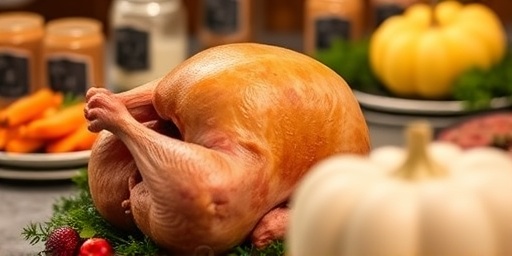
As American families gear up for the holiday season, there’s good news at the grocery store: the average cost of a Thanksgiving dinner has decreased by 5% this year, marking the third consecutive year of declining prices. According to the American Farm Bureau Federation’s annual survey, a classic meal for 10 people—featuring turkey, stuffing, sweet potatoes, and all the traditional fixings—now averages $49.20, down from $51.91 in 2022. Leading the charge in consumer savings is the star of the table: turkey prices have plummeted more than 16%, making this year’s bird a bargain compared to last year’s hefty tags.
Turkey Prices Lead the Charge in Holiday Bargains
The dramatic drop in turkey prices is stealing the spotlight this Thanksgiving. Fresh, whole turkeys are now priced at an average of $1.50 per pound, a 16.3% decrease from $1.80 per pound in 2022, according to USDA data. This decline is attributed to a bumper crop of turkeys and improved supply chain efficiencies following years of pandemic-related disruptions. For a standard 16-pound bird, that translates to about $24—saving families roughly $4.80 compared to last year.
Industry experts point to favorable weather conditions in key turkey-producing states like Minnesota, North Carolina, and Arkansas as a major factor. ‘We’ve seen record production levels this year, with over 230 million turkeys raised for the holiday season,’ said Dr. Emily Carter, an agricultural economist at Purdue University. ‘This oversupply has naturally driven down prices, providing significant consumer savings amid ongoing concerns about food prices.’
But it’s not just the fresh birds seeing relief; frozen turkeys are even cheaper at $1.35 per pound, down 18%. Retailers like Walmart and Kroger have ramped up promotions, with some offering turkeys for as low as 49 cents per pound when paired with qualifying purchases. This aggressive pricing strategy is designed to draw in shoppers for the full Thanksgiving dinner basket, boosting overall sales despite the lower margins on poultry.
Broader Food Prices Show Mixed but Encouraging Trends
While turkey prices dominate the headlines, the overall basket of Thanksgiving dinner staples reflects a broader easing in food prices. Items like cranberries, pumpkin pie mix, and dinner rolls have seen modest declines, contributing to the 5% nationwide drop. For instance, a 12-ounce bag of fresh cranberries now costs $2.47, a 1.2% decrease, while a 16-ounce can of pumpkin pie filling is down 0.9% to $3.82.
However, not every ingredient is playing nice with the savings narrative. Green bean casserole components, including green beans and cream of mushroom soup, have ticked up slightly by 2-3%, bucking the trend due to seasonal demand spikes. Stuffing mix remains stable at $2.50 for a 6-ounce package, offering little change from last year. The survey highlights that these variations underscore the complex dynamics of food prices influenced by everything from fuel costs to global trade.
In the context of inflation, which peaked at 9.1% in 2022 but has cooled to around 3.7% this year per the Bureau of Labor Statistics, these reductions signal a welcome respite. ‘Inflation in the food sector has moderated significantly, with poultry leading the way in deflationary pressures,’ noted USDA Chief Economist Joseph Glauber in a recent report. ‘This year’s Thanksgiving dinner cost drop is a direct result of those stabilizing forces, allowing for real consumer savings at a time when household budgets are still stretched.’
To illustrate the breakdown, here’s a quick comparison of key items:
- Turkey (16 lb): $24.00 (down 16%)
- Stuffing (two 6-oz boxes): $5.00 (stable)
- Sweet Potatoes (3 lb): $3.96 (up 1%)
- Cranberries (12 oz): $2.47 (down 1%)
- Pumpkin Pie (ingredients): $7.64 (down 1%)
- Pecans (half cup): $3.33 (up 2%)
- Green Beans (2 lb): $2.88 (up 3%)
- Cream of Mushroom Soup (two 10.5-oz cans): $2.72 (up 2%)
- Dinner Rolls (one dozen): $3.82 (up 9%)
- Milk (1 gallon): $3.44 (down 2%)
- Cubed Bread for Stuffing (1 lb): $2.16 (stable)
These figures, compiled from surveys across 32 states representing diverse retail markets, show that while some costs have risen, the overall effect is a lighter load on wallets.
Regional Differences Highlight Local Food Price Dynamics
Thanksgiving dinner costs aren’t uniform across the U.S.—regional variations paint a patchwork of savings opportunities. In the Midwest, where turkey production is robust, families can expect to pay as little as $45 for the full meal, thanks to lower transportation costs and abundant local supply. States like Iowa and Indiana report turkey prices dipping below $1.40 per pound, amplifying consumer savings in heartland communities.
Contrast that with the West Coast, where urban markets like California see averages closer to $55 due to higher labor and logistics expenses. Here, food prices for sides like sweet potatoes and pecans are elevated by 5-7%, influenced by droughts affecting crop yields. ‘Coastal inflation in groceries remains stickier, but even there, turkey prices are providing a counterbalance,’ explained regional analyst Maria Lopez from the California Farm Bureau.
In the South, hurricane recovery efforts have stabilized supply chains, leading to a 6% overall drop in meal costs. Florida and Texas shoppers are benefiting from imported produce that keeps items like green beans affordable. Meanwhile, the Northeast faces the highest averages at $52, with dinner rolls and milk seeing upticks from energy cost pass-throughs. These disparities encourage savvy consumers to shop regionally or even cross state lines for deals, turning Thanksgiving dinner planning into a strategic exercise in maximizing savings.
A deeper dive into urban vs. rural divides reveals that small-town grocers often undercut big-box stores by 3-5% on staples, making rural areas hotspots for budget-friendly feasts. This year’s data, gathered from over 200 volunteers shopping at various retailers, underscores how local factors like weather and distribution networks shape the national trend of declining food prices.
Experts Predict Sustained Relief Amid Economic Shifts
Looking ahead, agricultural economists forecast that consumer savings on Thanksgiving dinner could extend into 2024, provided inflation continues its downward trajectory. With global grain prices stabilizing after the Ukraine conflict’s disruptions, feed costs for livestock—including turkeys—are expected to remain low. ‘We’re entering a phase of moderate food price growth, around 2-3%, which bodes well for holiday budgets,’ said Mark Lange, vice president of the International Dairy Foods Association, commenting on ancillary items like milk and cheese.
However, potential headwinds loom. Climate change-induced weather events could spike vegetable prices, and labor shortages in processing plants might reverse some turkey price gains. The Farm Bureau warns that if avian flu outbreaks return, as they did in 2022, supply could tighten quickly. On the positive side, technological advances in farming, such as precision agriculture, are enhancing yields and efficiency, further curbing inflation in food prices.
Consumer advocacy groups are urging families to capitalize on these trends. ‘This third year of declining costs is a green light for hosting larger gatherings without financial strain,’ advised Lisa Hawkins from the Consumer Federation of America. She recommends buying in bulk, using loyalty programs, and incorporating seasonal produce to stretch savings. Retail forecasts predict a 4% uptick in Thanksgiving grocery sales volume, as lower prices encourage more elaborate meals.
Government policies also play a role. Recent USDA investments in rural infrastructure aim to reduce distribution costs, potentially lowering food prices long-term. As inflation eases, the Federal Reserve’s interest rate adjustments are indirectly supporting agricultural lending, enabling farmers to maintain production levels that keep turkey prices and other staples affordable.
In essence, this year’s Thanksgiving dinner landscape offers a tale of resilience. From farm to table, the ecosystem of producers, distributors, and retailers has adapted to deliver real value. Families planning their holiday menus can look forward to more bang for their buck, fostering traditions without the burden of escalating costs. As we approach November 23, 2023, the focus shifts to gratitude—not just for the meal, but for the economic winds that make it possible.