

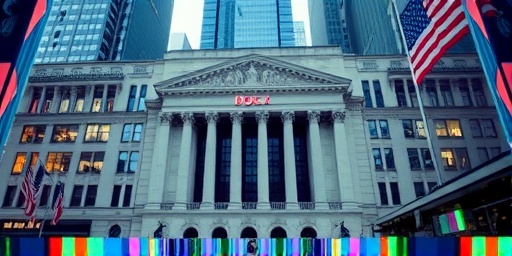
In a dramatic late-session surge, the U.S. Stock market closed higher on Wednesday, propelled by robust gains in tech stocks and escalating optimism surrounding a potential Federal Reserve rate cut at its December policy meeting. The Dow Jones Industrial Average jumped 1.2% to 42,500 points, while the S&P 500 climbed 1.8% to a fresh record above 5,900. The Nasdaq Composite, heavily weighted toward technology, soared 2.5%, marking its strongest daily performance in months. This rally comes amid renewed investor fervor for AI-driven innovations, with standout performers like Alphabet and Nvidia leading the charge.
The momentum built as traders digested the latest economic data, including softer-than-expected inflation figures from the Producer Price Index, which eased 0.1% in October—below forecasts and signaling cooling price pressures. This bolstered bets that the Federal Reserve could implement a 25-basis-point rate cut next month, with futures markets now pricing in an 85% probability, up from 70% earlier in the week. "The combination of resilient tech stocks and dovish Federal Reserve signals is creating a perfect storm for market upside," said Michael Santoli, senior markets commentator at CNBC.
AI Powerhouses Alphabet and Nvidia Fuel Tech Sector Boom
At the epicenter of the Stock market rally were AI titans Alphabet and Nvidia, whose shares catapulted as investors piled into companies at the forefront of artificial intelligence advancements. Alphabet, Google’s parent company, saw its stock rise 3.1% to $178 per share, buoyed by reports of accelerating AI integration across its cloud services and search ecosystem. The company’s Google Cloud division reported a 35% year-over-year revenue increase in its latest quarterly earnings, driven largely by demand for AI tools like the Gemini model, which is competing head-on with rivals in generative AI.
Nvidia, the undisputed leader in graphics processing units essential for AI training, didn’t lag behind, with shares surging 4.2% to $135. This performance extended Nvidia’s year-to-date gains to over 180%, underscoring its pivotal role in the AI revolution. Analysts attribute the spike to Nvidia’s announcement of its next-generation Blackwell chips, expected to hit the market in early 2025, promising up to 30 times the performance of current models for AI workloads. "Nvidia’s dominance in AI hardware is not just a trend—it’s reshaping the entire tech stocks landscape," noted Wedbush Securities analyst Dan Ives in a research note. The chipmaker’s market cap now exceeds $3.3 trillion, making it the world’s most valuable company and a bellwether for broader Stock market sentiment.
Beyond these giants, the tech stocks sector as a whole posted a 2.8% gain, with semiconductors and software firms like AMD and Microsoft also advancing. AMD climbed 2.9% on rumors of expanded partnerships with data center operators for AI accelerators, while Microsoft rose 1.7%, supported by its Azure cloud platform’s growing AI adoption. This collective surge highlights how AI is no longer a niche buzzword but a core driver of economic growth, with projections from McKinsey estimating that AI could add $13 trillion to global GDP by 2030.
Federal Reserve’s Dovish Stance Ignites Rate Cut Fever
The Federal Reserve‘s recent communications have been the spark igniting hopes for a rate cut, transforming market dynamics overnight. Fed Chair Jerome Powell’s comments during a speech in Dallas emphasized that while the economy remains robust, persistent downside risks to employment warrant a measured easing of monetary policy. "We are well positioned to respond to evolving data," Powell stated, a phrase interpreted by markets as a green light for continued rate reductions following September’s 50-basis-point trim.
Traders’ reactions were swift, with the 10-year Treasury yield dipping to 4.15%, its lowest in weeks, as bond investors anticipated looser Federal Reserve policy. This yield decline provided a tailwind for equities, particularly growth-oriented tech stocks, which thrive in low-interest environments by reducing borrowing costs for innovation-heavy firms. According to CME Group’s FedWatch Tool, the odds of a December rate cut have climbed to 85%, while expectations for additional cuts in 2025 now total 100 basis points—more aggressive than the Fed’s own projections.
Economic indicators supporting this shift include the October jobs report, which added 12,000 positions but revealed a labor force participation rate holding steady at 62.7%. Unemployment ticked up slightly to 4.2%, prompting concerns about a softening job market that could push the Federal Reserve toward more accommodative measures. Economists at Goldman Sachs revised their 2025 GDP forecast downward to 2.1% from 2.3%, citing potential headwinds from higher-for-longer rates, but they remain bullish on stock market prospects if rate cuts materialize. "A December rate cut would signal the Fed’s commitment to a soft landing, boosting confidence across sectors," said Lindsay Rosner, chief economist at Goldman Sachs.
Broad Market Gains Extend Beyond Tech to Energy and Finance
While tech stocks stole the spotlight, the rally’s breadth revealed underlying strength in other corners of the stock market. The energy sector, buoyed by rising oil prices amid geopolitical tensions in the Middle East, advanced 1.5%, with ExxonMobil gaining 2.1% as crude futures settled above $75 per barrel. This uptick was partly attributed to supply disruption fears following Houthi attacks on Red Sea shipping lanes, which could tighten global energy markets.
In finance, banks like JPMorgan Chase rose 1.4%, benefiting from expectations that a Federal Reserve rate cut would ease pressure on loan portfolios while stimulating borrowing demand. The financial sector’s 1.1% increase was the strongest since July, reflecting optimism about net interest margins stabilizing post-rate hikes. Consumer discretionary stocks also perked up, with Amazon climbing 2.3% on strong e-commerce sales data and holiday season forecasts enhanced by AI-powered personalization tools.
However, not all segments participated equally. Defensive sectors like utilities dipped 0.3%, as investors rotated out of safe havens into riskier assets amid the positive Federal Reserve outlook. Volatility, as measured by the VIX index, fell to 15.2, its lowest in a month, indicating reduced fear and a conducive environment for sustained stock market gains. International markets echoed the sentiment, with Europe’s STOXX 600 up 1.2% and Asia’s Nikkei closing 0.8% higher, underscoring the global ripple effects of U.S. tech stocks and Federal Reserve policies.
Investor Strategies Shift Toward AI and Rate-Sensitive Plays
As the dust settles on this stock market surge, investors are recalibrating portfolios to capitalize on the AI boom and impending Federal Reserve rate cut. Hedge funds and retail traders alike are increasing allocations to tech stocks, with exchange-traded funds like the Invesco QQQ Trust seeing inflows of $2.5 billion last week alone. "The confluence of AI breakthroughs and monetary easing makes this a pivotal moment for growth investing," advised Sarah Kunst, a venture capitalist at Cleo Capital, in an interview with Bloomberg.
Looking ahead, market watchers are eyeing the November non-farm payrolls report and the Fed’s next meeting minutes for further clues on the rate cut trajectory. If inflation continues to moderate—core PCE is projected at 2.6% for October—the path to multiple cuts in 2025 could open, potentially lifting the S&P 500 toward 6,200 by year-end, per strategists at Morgan Stanley. Yet, risks linger, including election uncertainties and potential AI regulatory hurdles from antitrust probes into Big Tech.
For everyday investors, experts recommend diversification: blending AI-focused tech stocks with rate-sensitive cyclicals like industrials, which gained 1.6% today on infrastructure spending hopes. Robo-advisors from Vanguard and Fidelity have already adjusted models to overweight semiconductors and cloud computing, anticipating sustained momentum. As one portfolio manager at BlackRock put it, "In this environment, ignoring AI and Federal Reserve signals is akin to betting against the future of innovation."
The rally’s implications extend to the broader economy, where cheaper borrowing could spur business investments in AI infrastructure, potentially accelerating productivity gains. Small-cap stocks, via the Russell 2000, rose 1.9%, hinting at a broadening recovery that benefits Main Street alongside Wall Street. With corporate earnings season ramping up—Apple and Tesla report next week—the stock market could sustain its upward trajectory if tech stocks deliver on AI promises and the Federal Reserve follows through on rate cut expectations.