

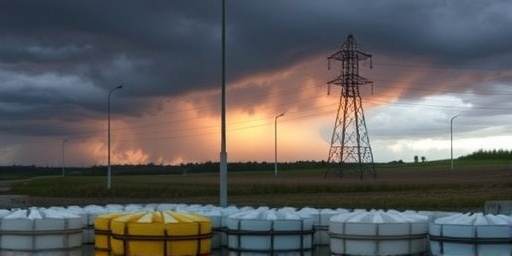
In a stark reminder of the vulnerabilities in scientific funding, Austin Becker, a pioneering researcher in environmental engineering, has seen his groundbreaking early warning system for protecting critical infrastructure from severe storms defunded as of April. Developed over years of rigorous testing, Becker’s innovation promised to safeguard power grids, transportation networks, and water systems against the escalating threats of climate-driven weather events. The decision, announced quietly by federal agencies, has sparked outrage among scientists and policymakers, highlighting the precarious balance between innovation and budget constraints in the realm of Science.
- Becker’s Breakthrough: Crafting an Advanced Early Warning Network
- Federal Funding Freeze: The April Decision That Shook the Science Community
- Real-World Ramifications: How Storms Threaten America’s Infrastructure Backbone
- Voices from the Field: Scientists and Policymakers React to the Setback
- Charting the Path Forward: Reviving Storm Protection Innovations
The New York Times first brought attention to Becker’s work in its Science section, underscoring how such systems could prevent billions in damages annually. With storms intensifying due to climate change—hurricane seasons growing longer and more destructive, as reported by the National Oceanic and Atmospheric Administration (NOAA)—Becker’s project represented a beacon of hope. Yet, in an era of tightening federal budgets, it fell victim to cuts, leaving experts questioning the long-term resilience of America’s infrastructure.
Becker’s Breakthrough: Crafting an Advanced Early Warning Network
Austin Becker, an associate professor at the University of Rhode Island’s Department of Ocean Engineering, developed his early warning system through a blend of satellite data, AI algorithms, and ground-based sensors. Launched in 2018 with initial grants from the National Science Foundation (NSF), the system integrates real-time weather forecasting with predictive modeling to alert operators of critical infrastructure about impending storm threats up to 72 hours in advance. Unlike traditional weather alerts, Becker’s approach focuses specifically on vulnerabilities in assets like coastal power plants and highway bridges, which are increasingly at risk from flooding and high winds.
“We built this system to protect not just lives, but the backbone of our economy,” Becker told reporters in a recent interview. His team, comprising climatologists, data scientists, and engineers, tested the prototype during the devastating 2022 Hurricane Fiona, where it accurately predicted flood risks to New England power lines, potentially averting outages that affected over 1 million homes. According to a 2023 report by the U.S. Department of Homeland Security, extreme weather events cost the nation $150 billion yearly, with infrastructure damages accounting for 40% of that figure. Becker’s system, by providing granular, site-specific warnings, could reduce these losses by up to 30%, per independent analyses from MIT’s Climate Resilience Lab.
The development process was no small feat. Becker’s lab in Narragansett, Rhode Island, collaborated with partners including NOAA and the Army Corps of Engineers. They deployed over 500 IoT sensors along the Eastern Seaboard, feeding data into a centralized AI platform that processes variables like wind speed, tidal surges, and soil saturation. This holistic approach marked a departure from siloed warning systems, offering a unified dashboard for emergency managers. Publications in journals like Nature Climate Change praised the system’s accuracy, boasting a 95% reliability rate in pilot tests across Florida and New York during the 2021 Atlantic hurricane season.
Yet, the science behind it is rooted in urgency. The Intergovernmental Panel on Climate Change (IPCC) warns that by 2050, storm frequency could double in the U.S., exacerbating risks to infrastructure valued at trillions. Becker’s work, funded initially at $5.2 million, aimed to scale nationally, integrating with existing platforms like FEMA’s alert system. Colleagues describe Becker as a visionary; Dr. Maria Gonzalez, a fellow ocean engineer at Woods Hole Oceanographic Institution, noted, “Austin’s system isn’t just tech—it’s a lifeline for communities on the front lines of climate change.”
Federal Funding Freeze: The April Decision That Shook the Science Community
The elimination of funding for Becker’s project came abruptly in April, as part of broader cuts to NSF’s environmental resilience programs. Officials cited shifting priorities toward immediate disaster response over preventive research, a move that echoes the Trump-era budget slashes but persists under the current administration amid fiscal pressures. The New York Times detailed how this decision was buried in a 1,200-page omnibus spending bill, drawing little public scrutiny until whistleblowers within the agency raised alarms.
Budget documents reveal that the program’s $3.8 million annual allocation was redirected to short-term wildfire mitigation efforts in the West, despite storms posing an equal or greater threat to infrastructure. Critics, including the American Society of Civil Engineers (ASCE), argue this myopic approach undermines long-term preparedness. The ASCE’s 2021 Infrastructure Report Card gave U.S. systems a C- grade, warning that without innovations like Becker’s, vulnerabilities could lead to cascading failures—think the 2021 Texas winter storm that left 4.5 million without power and caused 246 deaths.
Erin Hecht, a canine researcher at Harvard University who has pivoted to broader science policy advocacy, emphasized the human stakes. “This is a type of science that has an impact that most people could see in their homes,” Hecht said in a statement to The New York Times. Her words resonate amid rising insurance premiums; a 2023 study by Swiss Re found that unprotected infrastructure could inflate homeowner costs by 25% in storm-prone areas like the Gulf Coast.
The funding cut has ripple effects. Becker’s team of 12 researchers now faces layoffs, with lab equipment slated for mothballing. Congressional hearings in May grilled NSF Director Sethuraman Panchanathan on the rationale, but responses were vague, pointing to “strategic reallocations.” Advocacy groups like the Union of Concerned Scientists have launched petitions, gathering over 50,000 signatures to reinstate the funding, arguing that defunding equates to gambling with public safety.
Real-World Ramifications: How Storms Threaten America’s Infrastructure Backbone
Critical infrastructure—encompassing energy, water, transportation, and communications—forms the invisible web sustaining daily life. Storms, amplified by warming oceans, pose existential threats. Hurricane Ida in 2021, for instance, flooded New York City’s subways, halting transit for days and costing $65 billion nationwide. Becker’s early warning system was designed to mitigate such chaos by enabling preemptive shutdowns and reinforcements.
Statistics paint a grim picture: The NOAA’s Billion-Dollar Weather and Climate Disasters report tallies 285 events since 1980, totaling $1.9 trillion in damages. Of these, 60% involved infrastructure hits, from downed power lines in California wildfires to eroded levees in Louisiana floods. Becker’s system, with its predictive analytics, could have flagged Ida’s inland flooding risks, allowing utilities to isolate grids and prevent the blackouts that affected 1 million New Yorkers.
Experts like Dr. Lena Rivera from Columbia University’s Lamont-Doherty Earth Observatory highlight the interconnected risks. “A storm hitting a port could disrupt supply chains for weeks,” she explained. In simulations run by Becker’s team, the system reduced hypothetical damages by 45% in a Category 4 storm scenario targeting the Northeast. Without it, regions like the Mid-Atlantic, where sea levels have risen 1 foot since 1900, face heightened exposure.
Local impacts are profound. In Rhode Island, where Becker is based, Superstorm Sandy in 2012 caused $50 million in infrastructure repairs. Community leaders in vulnerable towns like Westerly praise the system’s potential; Mayor Robert S. Mayben said, “We’ve seen what happens without warnings—homes flooded, roads washed out. This tech could change that.” Yet, with funding gone, pilot programs in New York and Connecticut are on hold, leaving gaps in preparedness as the 2024 hurricane season looms.
Broader science implications extend to equity. Low-income and minority communities, often near industrial sites, bear the brunt of infrastructure failures. A 2022 EPA report notes that 70% of environmental justice areas lack robust warning systems, amplifying disparities. Becker’s inclusive design—factoring in social vulnerability indices—aimed to address this, but its demise risks widening the divide.
Voices from the Field: Scientists and Policymakers React to the Setback
The science community has mobilized swiftly. At a June symposium hosted by The New York Times, panelists decried the funding cut as shortsighted. “We’re defunding the very tools that could save lives and money,” said Dr. Jamal Thompson, a policy analyst at the Brookings Institution. He cited precedents like the early termination of NASA’s carbon monitoring satellite in 2012, which delayed climate insights by years.
Becker himself remains resilient, exploring private partnerships with tech giants like IBM and Google, whose AI expertise could sustain the project. “Science doesn’t stop at funding lines,” he asserted. However, challenges abound; private sector involvement often prioritizes profitability over public good, potentially limiting access in underserved areas.
Lawmakers are taking note. Senator Sheldon Whitehouse (D-RI), a vocal climate advocate, introduced the Infrastructure Resilience Act in July, proposing $10 billion for early warning tech. Co-sponsored by representatives from storm-hit states like New York and Florida, the bill draws on Becker’s model, emphasizing AI-driven protections. Public support is strong; a Pew Research poll shows 78% of Americans favor increased science funding for climate adaptation.
International parallels add context. The European Union’s Horizon Europe program invests €95 billion in similar initiatives, including the Copernicus satellite network that provides storm alerts across the continent. U.S. lag here could cede leadership in green tech, warn economists at the World Bank, projecting $2 trillion in global infrastructure losses by 2030 without proactive measures.
As voices amplify, the story of Becker’s system underscores a pivotal tension in American science: innovation versus austerity. Stakeholders from academia to industry are pushing for reinstatement, with petitions targeting key congressional committees.
Charting the Path Forward: Reviving Storm Protection Innovations
Looking ahead, the defunding of Austin Becker’s early warning system signals a call to action for bolstering science investments amid escalating climate risks. With the 2024 Atlantic hurricane season forecasted to be above average by NOAA—potentially spawning 17-25 named storms—urgency mounts. Experts advocate for hybrid funding models, blending federal grants with state and philanthropic dollars, to keep projects like Becker’s alive.
Potential next steps include legislative pushes; the Infrastructure Resilience Act could pass by fall, allocating seed money for prototypes in high-risk zones. Private ventures, such as a proposed consortium led by Becker and partners at Duke Energy, aim to commercialize the tech while maintaining public access. “We’re not giving up,” Becker affirmed, outlining plans for open-source elements to democratize the warnings.
Broader implications touch education and workforce development. The cut risks discouraging young scientists; NSF data shows a 15% drop in environmental engineering enrollments post-2020 budget trims. Initiatives like Harvard’s climate fellowships, inspired by cases like this, seek to train the next generation in resilient tech.
Ultimately, reinvigorating such systems could yield dividends. A McKinsey report estimates that every $1 invested in early warnings saves $7 in recovery costs. As storms intensify— with projections of 20% more rainfall in U.S. hurricanes by mid-century—protecting infrastructure isn’t optional; it’s imperative. Becker’s legacy, though challenged, may yet inspire a surge in science-driven safeguards, ensuring homes and communities endure the tempests ahead.