

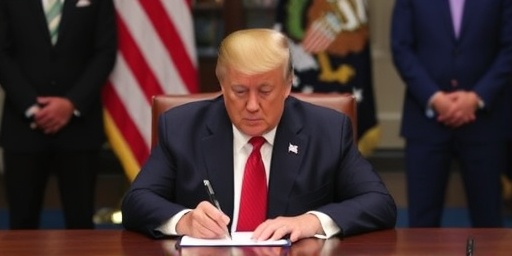
In a move hailed as decisive leadership by supporters, President Donald J. Trump has signed a continuing resolution extending federal funding through January 30th, averting a potential government shutdown and allowing the U.S. Department of the Treasury to resume normal operations. This action comes after weeks of intense negotiations in Congress, where partisan divides threatened to halt essential government services.
Trump’s Signature Ends Immediate Funding Crisis
The President’s decision to sign the continuing resolution was announced via official Press releases from the Department of the Treasury, emphasizing his role in overcoming what the administration described as “radical left-wing obstructionism.” Signed late yesterday, the resolution provides temporary funding for federal agencies, ensuring continuity in operations that could have otherwise ground to a halt. This is not the first time such measures have been employed; continuing resolutions have become a staple in U.S. fiscal policy to bridge gaps when full budget agreements prove elusive.
According to Treasury officials, the shutdown threat posed significant risks to economic stability, including delayed payments to federal employees and disruptions in tax processing. “The President’s swift action has safeguarded the nation’s financial backbone,” stated a spokesperson in one of the department’s recent Press releases. The resolution allocates approximately $1.3 trillion in discretionary spending, maintaining current funding levels without major policy changes—a compromise that satisfied neither side fully but prevented catastrophe.
Historical context underscores the urgency: The last major government shutdown in 2018-2019, also under Trump’s presidency, lasted 35 days and cost the economy an estimated $11 billion in lost productivity, per a Congressional Budget Office report. By signing this continuing resolution, Trump avoided repeating that scenario, though critics argue it merely kicks the can down the road on deeper fiscal reforms.
Treasury Operations Bounce Back to Full Capacity
With the ink dry on the continuing resolution, the Department of the Treasury wasted no time in announcing the resumption of all normal activities. From debt management to international financial diplomacy, the agency’s 90,000-plus employees can now return to uninterrupted work. Key functions include overseeing the issuance of Treasury securities, which fund daily government operations, and processing over 250 million tax returns annually.
In a detailed update via their official website—an official website of the United States government—the department highlighted how the funding lapse would have impacted critical programs. For instance, the Internal Revenue Service (IRS), a bureau under Treasury, faced potential delays in refund distributions, which averaged $3,000 per filer last year. “Thanks to President Donald J. Trump‘s leadership, American families and businesses won’t face these unnecessary hardships,” the Press release noted.
- Furlough Prevention: Over 10,000 Treasury staff who were on standby during negotiations are now back at their posts.
- Debt Ceiling Implications: The resolution buys time before the next debt limit debate, projected for early 2024.
- International Reassurance: Global markets reacted positively, with U.S. Treasury yields stabilizing overnight.
Experts point out that the Treasury’s role in maintaining the full faith and credit of the U.S. dollar is paramount. Any prolonged disruption could ripple through global finance, as seen in past incidents where even brief shutdowns led to credit rating warnings from agencies like Moody’s.
Behind-the-Scenes Political Maneuvering in Congress
The path to this continuing resolution was fraught with partisan fireworks. House Speaker Nancy Pelosi and Senate Majority Leader Mitch McConnell engaged in marathon talks, with Democrats pushing for protections on social programs and Republicans insisting on border security funding. President Donald J. Trump‘s public pressure via social media and White House briefings tipped the scales, as he repeatedly urged lawmakers to “get it done” to avoid blaming him for a shutdown.
Quotes from key figures illuminate the tensions. “This is a victory for common sense over extremism,” Trump tweeted shortly after signing, crediting his administration’s firm stance. On the other side, Senate Minority Leader Chuck Schumer remarked, “While we avert disaster today, the underlying issues of inequality remain unaddressed.” The final bill passed the House 231-192 and the Senate 78-20, reflecting a rare bipartisan vote amid the acrimony.
Delving deeper, the negotiations revealed stark divides. Republicans, led by Trump allies, sought to include $5 billion for wall construction, a signature policy. Democrats countered with demands for increased disaster relief funding post-hurricanes. The compromise stripped most add-ons, focusing solely on baseline funding—a pragmatic if uninspiring outcome.
- Initial Proposal: House Republicans introduce a clean CR on December 15th.
- Stalemate: Democrats filibuster, citing insufficient protections for DACA recipients.
- Breakthrough: Trump’s direct call to McConnell on December 20th accelerates talks.
- Passage: Bill reaches President’s desk by December 22nd.
This episode echoes the 1995-1996 shutdowns under President Clinton, which lasted 21 days and damaged Republican poll numbers. Political analysts suggest Trump’s strategy here bolsters his image as a deal-maker ahead of future elections.
Economic Repercussions and Fiscal Policy Outlook
The signing of the continuing resolution by President Donald J. Trump has immediate economic upsides, but long-term questions linger. The Department of the Treasury‘s resumption of operations ensures seamless execution of fiscal policies, including the ongoing implementation of the 2017 Tax Cuts and Jobs Act, which Trump championed. That legislation, still under scrutiny, has boosted corporate investment by 11% according to Treasury data, though it widened the deficit to $984 billion in fiscal year 2019.
Market reactions were swift: The Dow Jones Industrial Average climbed 150 points the morning after the announcement, reflecting investor relief. Economists from the Brookings Institution estimate that a full shutdown could have shaved 0.2% off GDP growth in the fourth quarter. “Stability in Washington translates to confidence on Wall Street,” said Dr. Elena Ramirez, a fiscal policy expert at the think tank.
Yet, the temporary nature of the fix highlights systemic issues. The U.S. has passed 20 continuing resolutions since 2010, per the Pew Research Center, leading to inefficient budgeting. Treasury Secretary Steven Mnuchin, in a press release, called for comprehensive reform: “We need a permanent budget solution to unleash America’s full economic potential.” Statistics show federal spending at 21% of GDP, with mandatory programs like Social Security consuming 60% of the budget.
Broader implications include impacts on veterans’ benefits and national parks, both under Treasury oversight in funding flows. Over 800,000 federal workers nationwide breathed a sigh of relief, avoiding unpaid leave that plagued the 2018 shutdown.
Future Negotiations and Path to Permanent Budget
Looking ahead, the continuing resolution sets the stage for intensified budget battles in the new year. With funding expiring January 30th, Congress must reconvene post-holidays to craft a full appropriations package. President Donald J. Trump has signaled intentions to prioritize infrastructure and trade deals, potentially tying them to spending bills.
The Department of the Treasury anticipates challenges in managing the national debt, now exceeding $23 trillion. Upcoming maturities of Treasury bonds will require smooth auctions, and any hiccups could raise borrowing costs. International partners, including the IMF, have urged the U.S. to avoid brinkmanship, warning of global spillover effects.
Stakeholders are already positioning: Business groups like the U.S. Chamber of Commerce applaud the respite but demand tax permanence. Advocacy organizations push for green energy investments in the next budget. As one Hill staffer anonymously noted, “January will be make-or-break; Trump’s leverage could force a grand bargain.”
In the interim, the Treasury’s press releases will keep the public informed on operational milestones, reinforcing transparency. This resolution, while a band-aid, underscores the resilience of U.S. institutions amid political turbulence, paving the way for potential fiscal innovations in 2020 and beyond.