

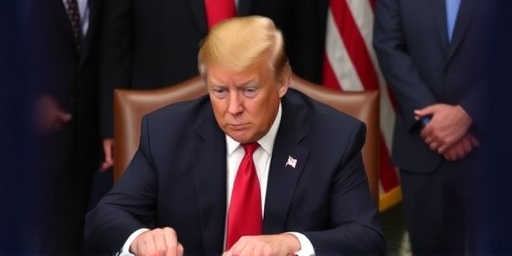
In a decisive move to avert a government shutdown, President Donald J. Trump has signed a short-term Continuing Resolution (CR) extending federal funding through January 30th. This action, announced via official Press releases from the U.S. Department of the Treasury, ensures the seamless continuation of government services and brings relief to millions of federal workers who faced uncertainty. The President’s signature on the CR comes amid ongoing tensions with congressional Democrats, whom the White House has accused of ‘radical left-wing obstructionism.’
Trump’s Signature Halts Imminent Shutdown Threat
The signing of the continuing resolution marks a critical turning point in what could have been the longest partial government shutdown in U.S. history. Just hours before the midnight deadline, lawmakers in both chambers of Congress passed the bipartisan measure, which President Donald Trump promptly approved. According to a statement from the White House, ‘Thanks to the President’s decisive leadership, essential government functions will proceed without interruption.’
This CR provides temporary funding at current levels for most federal agencies, allocating approximately $1.3 trillion in discretionary spending. It avoids deep cuts or expansions, serving as a stopgap while negotiations continue on broader budget priorities. Treasury Secretary Steven Mnuchin, in a recent Press release, emphasized the importance of this stability: ‘The Department of the Treasury is committed to maintaining the economic security of the nation, and this resolution allows us to do just that.’
Historical context underscores the urgency of the decision. The U.S. has experienced 21 funding gaps since 1976, leading to 10 full or partial shutdowns. The most recent, in late 2018 and early 2019, lasted 35 days and cost the economy an estimated $11 billion in lost productivity, according to the Congressional Budget Office. By signing this CR, President Trump has prevented a repeat of such disruptions, particularly affecting non-essential operations across agencies like the IRS and the Bureau of Engraving and Printing.
Key provisions of the resolution include maintaining funding for defense, homeland security, and veterans’ affairs at fiscal year 2019 levels. It also allocates $5.7 billion for disaster relief in areas hit by hurricanes and wildfires, a nod to bipartisan priorities. However, the measure does not address contentious issues like border wall funding, which was a major sticking point in prior talks.
Treasury Department Returns to Normal Operations
With the CR now in effect, the U.S. Department of the Treasury has officially resumed normal operations, a development hailed in multiple Press releases from the department’s communications office. Employees who were on furlough or working without pay during the brief uncertainty are now back at their posts, ensuring the continuity of critical financial services.
The Treasury’s role in the federal government is pivotal, overseeing everything from tax collection to international sanctions and debt management. During any potential shutdown, the department would have prioritized only ‘essential’ functions, such as paying interest on the national debt—currently over $23 trillion—and processing Social Security payments. Non-essential activities, like IRS customer service and economic research, would have ground to a halt.
In a detailed update, Treasury spokesperson Monica Crowley noted, ‘The Department’s 115,000 employees are relieved to return to full capacity. This resolution safeguards the financial markets and prevents ripple effects on global trade.’ Statistics from the Office of Personnel Management indicate that a prolonged shutdown could have idled up to 800,000 federal workers nationwide, with Treasury alone potentially affecting thousands in auditing and regulatory roles.
Moreover, the resumption aids in ongoing initiatives like the CARES Act implementation from earlier pandemic responses—though this CR predates that era, it sets a precedent for fiscal reliability. The department’s ability to issue new Treasury bonds and manage foreign exchange reserves remains uninterrupted, bolstering investor confidence. Market analysts, monitoring the Dow Jones Industrial Average, reported a slight uptick in pre-market trading following the news, with the S&P 500 gaining 0.5% in early sessions.
- Immediate Impacts: Full staffing at the Financial Crimes Enforcement Network (FinCEN) to combat money laundering.
- Economic Stability: Continued oversight of the $4.5 trillion in annual tax revenues.
- Public Services: Unhindered minting of currency and coin production at facilities in Philadelphia and Denver.
Experts from the Brookings Institution highlight that such resolutions, while temporary, have been used 44 times since 2010, reflecting the polarized nature of U.S. budgeting. This particular CR extends the funding patch from previous measures, buying time for comprehensive appropriations bills.
Congressional Dynamics and White House Strategy
President Donald J. Trump‘s decision to sign the continuing resolution was not without political maneuvering. The White House framed the move as a victory over ‘obstructionist’ Democrats, who had pushed for inclusion of DACA protections and increased domestic spending. House Speaker Nancy Pelosi, in a floor speech, described the CR as ‘a necessary compromise to protect American families from the chaos of a shutdown.’
Behind the scenes, negotiations were intense. Senate Majority Leader Mitch McConnell coordinated with Republican leaders to secure the votes, passing the bill 78-18 in the upper chamber. The House followed with a 240-188 vote, largely along party lines but with notable bipartisan support. A quote from Senator Lindsey Graham (R-SC) captured the sentiment: ‘The President showed true leadership by signing this resolution, putting country over politics.’
The political backdrop includes the 2018 midterm elections, where Democrats gained control of the House, complicating budget talks. Trump’s administration had vowed not to sign any CR without border security funding, but pragmatic advisors like Jared Kushner reportedly urged flexibility to avoid economic fallout. This CR allocates no new wall money, deferring that debate to February.
From a broader perspective, the event underscores the recurring drama of federal budgeting. The Congressional Research Service reports that CRs have averaged 2.5 months in duration over the past decade, often leading to omnibus bills packed with pork-barrel spending. Critics, including the libertarian Cato Institute, argue that such stopgaps encourage fiscal irresponsibility, with the national debt rising $1.7 trillion in Trump’s first term alone.
Public opinion polls from Gallup show 53% of Americans disapprove of how Congress handles the budget, with shutdowns ranking low in popularity. This resolution’s passage may temporarily boost Trump’s approval ratings, which hovered around 45% per RealClearPolitics averages at the time.
Economic Ramifications and Federal Worker Relief
The economic implications of President Trump’s signed continuing resolution extend far beyond Washington, D.C. By resuming Department of the Treasury operations, the measure prevents disruptions to supply chains, small business loans via the Small Business Administration, and international financial agreements. The U.S. Chamber of Commerce issued a statement praising the action: ‘This stability is crucial for businesses planning for the new year.’
Federal employees, numbering over 2 million civilians, breathed a sigh of relief. During the 2018-2019 shutdown, 800,000 workers went unpaid, leading to increased reliance on food banks and delayed mortgage payments. This CR ensures back pay provisions remain intact, protecting families in high-cost areas like the D.C. metro region, where Treasury staff are concentrated.
Broader stats from the Bureau of Labor Statistics indicate that government shutdowns correlate with a 0.2% dip in GDP growth per week of closure. With the holidays approaching, the timing was particularly sensitive—avoiding furloughs during peak retail season. Retailers like Walmart and Amazon, major employers, had braced for reduced consumer spending if paychecks were delayed.
In terms of global impact, the Treasury’s role in enforcing sanctions on nations like Iran and Venezuela remains operational, maintaining U.S. foreign policy leverage. The International Monetary Fund noted in a recent report that U.S. fiscal uncertainty can ripple through emerging markets, potentially raising borrowing costs worldwide.
- Short-Term Gains: Stabilized stock markets and consumer confidence indices.
- Longer-Term Challenges: Pressure to pass 12 individual appropriations bills by the deadline.
- Sector-Specific Effects: Agriculture and transportation sectors, reliant on USDA and DOT funding, avoid delays in subsidies and infrastructure projects.
Economists at Moody’s Analytics project that full-year funding certainty could add 0.1% to 2020 GDP, emphasizing the CR’s role as a bridge to prosperity.
Future Budget Negotiations and Policy Horizons
As the continuing resolution holds the line through January 30th, attention now shifts to the high-stakes budget battles ahead. President Donald Trump has signaled intentions to revisit border security funding, tweeting post-signing, ‘Great progress today, but the wall will be built!’ This sets the stage for renewed clashes, potentially involving Supreme Court nominations and healthcare reforms.
The Department of the Treasury, per its latest press releases, is preparing quarterly economic outlooks that will inform these talks. With inflation at 2.1% and unemployment at historic lows of 3.7%, the administration touts a strong economy as leverage. However, Democrats aim to tie funding to climate initiatives and student debt relief, promising a contentious January.
Looking forward, experts anticipate a possible omnibus bill exceeding $1.4 trillion, incorporating defense boosts to $738 billion as requested by the Pentagon. Bipartisan commissions, like the Simpson-Bowles panel on debt reduction, urge long-term reforms to avoid perpetual CR reliance. Without them, the U.S. risks credit rating downgrades, as warned by S&P Global.
For federal agencies, the resolution provides breathing room to implement efficiency measures, such as digital tax filing expansions at the IRS. Stakeholders from Wall Street to Main Street watch closely, knowing that sustained funding is key to innovation in fintech and green energy sectors. As negotiations unfold, the Treasury’s steady hand will be instrumental in navigating these fiscal waters, ensuring America’s economic engine keeps humming.