

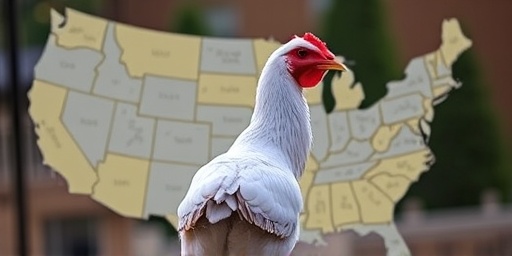
In a sobering development for public health, health officials in Washington state confirmed the first known human death in the United States from the H5N5 strain of bird flu. The victim, a 58-year-old man from rural eastern Washington, succumbed to severe respiratory complications after testing positive for the H5N5 bird flu variant last week. This marks a grim milestone in the ongoing battle against avian influenza, though experts stress that the virus does not currently pose a widespread pandemic threat.
The Washington State Department of Health announced the fatality on Friday, revealing that the man had been hospitalized in Spokane with symptoms including high fever, pneumonia, and multi-organ failure. He had occupational exposure to wild birds near his property, a common pathway for avian influenza transmission to humans. While the case is isolated, it underscores the evolving risks of bird flu strains crossing into human populations.
CDC epidemiologists are now leading a multi-agency investigation, sequencing the virus to determine its genetic makeup and potential for human-to-human spread. Preliminary findings indicate low transmissibility, similar to other avian strains like H5N1.
Washington Man’s Fatal Encounter with H5N5 bird flu
The victim, identified only as a longtime resident of Whitman County in Washington, first sought medical attention on October 15 after experiencing flu-like symptoms that rapidly worsened. According to hospital records released by state health officials, he developed acute respiratory distress syndrome (ARDS) within days, requiring mechanical ventilation. Tests conducted by the Washington State Public Health Laboratory confirmed the presence of H5N5 avian influenza A virus on October 18.
Family members told local media that the man frequently fed wild waterfowl on his property, a hobby that likely exposed him to infected birds. “He loved watching the ducks and geese come in during migration,” his daughter said in a statement. “We had no idea it could turn deadly like this.” No other household members have tested positive, and contact tracing is underway for over 50 individuals, including healthcare workers.
This incident is particularly alarming because H5N5, while circulating in wild birds across Asia and Europe for years, has only sporadically jumped to humans outside those regions. In Washington, recent surveillance detected the strain in mallard ducks sampled near the man’s home, linking it directly to local wildlife reservoirs.
Unpacking the H5N5 bird flu Strain: Deadlier Than H5N1?
The H5N5 subtype of avian influenza belongs to the highly pathogenic avian influenza (HPAI) family, known for causing severe illness in birds and occasional spillover to mammals, including humans. Unlike the more publicized H5N1, which has caused over 800 global human cases since 2003 with a 50% fatality rate, H5N5 has a sparser human track record. However, its emergence in North America raises questions about its adaptability.
Virologists explain that H5N5 shares genetic markers with reassortant viruses, where bird flu genes mix with those from seasonal flu strains. A 2023 study in the Journal of Virology identified H5N5 in European wild birds with mutations enhancing mammalian receptor binding, potentially explaining its virulence. In this Washington case, genomic analysis by the CDC revealed a unique North American clade, suggesting local evolution.
Statistics paint a broader picture: Since 2022, over 1,000 H5N5 bird flu detections have occurred in U.S. wild birds, per USDA reports, primarily along migratory flyways. Human cases remain rare—globally, fewer than 20 confirmed, with three fatalities in China. Washington’s case is the first U.S. death, contrasting with 13 non-fatal H5N1 infections in dairy workers earlier this year.
- Symptoms of H5N5: Fever, cough, shortness of breath, conjunctivitis; progresses to pneumonia in severe cases.
- Fatality Rate: Estimated 15-20% in documented human infections.
- Incubation: 2-5 days, faster than many flu strains.
Experts like Dr. Angela Rasmussen, a virologist at the University of Washington, noted, “H5N5’s high fatality in this patient doesn’t mean it’s inherently deadlier overall. Factors like age, comorbidities, and delayed antiviral treatment played roles.” The man had underlying diabetes and delayed seeking care, per reports.
CDC and Washington Health Teams Launch Urgent Investigation
The CDC has dispatched a field team to Washington, partnering with the state Department of Health and the USDA’s Animal and Plant Health Inspection Service (APHIS). Their goals: trace the virus’s origins, assess spillover risks, and evaluate vaccine preparedness.
“This is a reminder that avian influenza surveillance must remain robust,” said CDC Director Dr. Mandy Cohen in a press briefing. “The risk to the general public is low, but we’re monitoring closely, especially in high-exposure groups like poultry workers and hunters.” The agency has elevated H5N5 to ‘candidate vaccine virus’ status, accelerating development of a potential shot.
In Washington, Governor Jay Inslee activated emergency protocols, allocating $2 million for expanded testing. The state veterinary lab in Pullman is processing samples from over 200 wild birds weekly. “We’re not seeing sustained transmission,” said State Veterinarian Dr. Justin Kahler. “But this death compels us to double down on biosecurity.”
Quarantine measures are in place for nearby poultry farms, though no outbreaks reported yet. Federal funding under the 2024 Farm Bill bolsters these efforts, with $1 billion earmarked nationwide for avian flu response.
Avian Flu’s Growing Impact on Washington’s Agriculture and Economy
Washington’s $1.2 billion poultry industry faces heightened scrutiny following the H5N5 death. The state ranks among the top U.S. turkey producers, with 2023 outbreaks of related strains culling 5 million birds. Dairy farms, hit hard by H5N1 in neighboring states, report voluntary testing spikes.
Economic ripple effects are stark: A single HPAI outbreak can cost farms $10-20 million in losses, per Washington Farm Bureau estimates. Egg prices surged 20% regionally last year due to culls. This H5N5 case amplifies calls for federal aid; Senator Patty Murray (D-WA) urged Congress for expedited reimbursements.
Broader public health context includes spillover risks to other species. Sea mammals off Washington’s coast tested positive for H5 variants in 2023, and bobcats in nearby states. Climate change and wetland habitat loss are blamed for concentrating migratory birds, fueling virus spread.
- 2022-2024: 100+ million U.S. birds culled due to HPAI.
- Washington losses: $150 million since 2022.
- Human cases: 40+ globally for H5N1/H5N5 combined this year.
Industry leaders advocate for better wastewater surveillance, which detected H5N1 fragments in 15% of U.S. sites last month.
Public Health Strategies and Future Vigilance Against H5N5 Threats
As investigations continue, public health officials emphasize prevention. The CDC recommends avoiding contact with sick or dead wild birds, cooking poultry thoroughly, and reporting unusual animal deaths. High-risk groups—farmers, hunters, veterinarians—should use PPE and report symptoms immediately.
Antivirals like oseltamivir (Tamiflu) show promise against H5N5 in lab tests, with early treatment key to survival. Vaccination campaigns for poultry are expanding, with 40% of U.S. flocks protected by fall 2024.
Looking ahead, enhanced genomic surveillance via the CDC‘s FluView dashboard will track H5N5 mutations. International collaboration with WHO aims to map global flyways. Dr. Rasmussen added, “Preparedness averted pandemics before; it can again. But complacency is our enemy.”
Washington residents are urged to stay informed via state health alerts. With flu season underway, distinguishing bird flu from seasonal strains requires vigilant testing. This first U.S. H5N5 death, while tragic, galvanizes action to safeguard communities and agriculture alike.