

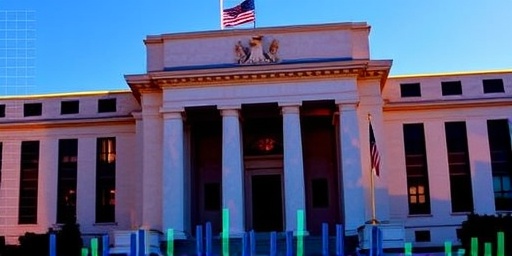
In a stunning pivot that caught economists and investors off guard, the US Federal Reserve announced a 50 basis point cut to its benchmark interest rates on Wednesday, lowering the federal funds rate to a range of 4.75% to 5.00%. This aggressive move aims to invigorate the economy as inflation continues to moderate, signaling the Fed‘s confidence in achieving a soft landing without tipping into recession.
The decision triggered an immediate euphoria on Wall Street, with the Dow Jones Industrial Average skyrocketing more than 2% to close at 41,200 points, its highest in months. The S&P 500 and Nasdaq also posted strong gains, up 2.3% and 2.8% respectively, as traders bet on renewed borrowing and spending to fuel growth.
Fed‘s Rationale: Taming Inflation While Sparking Growth
The Federal Reserve’s surprise rate cut comes at a pivotal moment for the US economy, where inflation has been steadily cooling from its pandemic-era peaks. Fed Chair Jerome Powell, in a post-announcement press conference, emphasized that recent data showed consumer prices rising at just 2.5% annually in August, down from over 9% in mid-2022. ‘With inflation moving sustainably toward our 2% target, we can now afford to ease monetary policy to support maximum employment and robust economic expansion,’ Powell stated.
This 0.5% reduction in interest rates marks the first cut since the Fed’s aggressive hiking cycle began in 2022 to combat runaway inflation fueled by supply chain disruptions and stimulus spending. Economists had anticipated a more modest 25 basis point trim, if any, making this half-point slash a bold statement. The Fed’s statement highlighted ‘progress on inflation’ while noting lingering risks from geopolitical tensions and labor market tightness.
Key economic indicators underpinning the decision include a unemployment rate holding steady at 4.2%, with nonfarm payrolls adding 142,000 jobs in August—below expectations but still indicative of resilience. GDP growth for the second quarter clocked in at 3.0%, outpacing forecasts and underscoring the economy’s underlying strength despite higher borrowing costs that have persisted for nearly two years.
Inflation metrics further bolster the Fed’s hand: The core Personal Consumption Expenditures (PCE) index, the central bank’s preferred gauge, rose 2.6% year-over-year in July, the slowest pace since 2021. Shelter costs, a major driver of recent inflation, have also begun to ease as rental markets stabilize post-pandemic migration shifts.
Wall Street’s Jubilant Response and Sector Winners
Markets wasted no time celebrating the Fed’s dovish turn. The Dow’s 2.1% surge was led by financials and consumer discretionary stocks, sectors poised to benefit from cheaper interest rates. Bank of America shares jumped 4.2%, while JPMorgan Chase climbed 3.5%, as lower rates are expected to reduce funding costs and boost loan demand.
Technology giants also rode the wave, with Apple and Microsoft each gaining over 3%, pushing the Nasdaq to new highs. Real estate investment trusts (REITs) soared, up an average of 5%, as mortgage rates—tied closely to the Fed’s benchmark—are likely to follow suit downward, stimulating homebuying activity dormant since 2022.
Bond yields reacted swiftly too, with the 10-year Treasury yield dipping to 3.85% from 4.1%, reflecting investor bets on sustained easing. Currency markets saw the US dollar weaken against major peers, with the euro strengthening 1.2% as global investors reposition for a less hawkish Fed.
Analysts from Goldman Sachs noted in a research note: ‘This cut validates our view that the economy can handle policy normalization without derailing growth. We’re raising our year-end S&P target to 5,800 from 5,600.’ However, not all reactions were uniformly positive; some energy stocks dipped amid concerns that lower rates could curb inflation pressures from commodity prices.
The broader market rally extended to commodities, with gold prices hitting $2,650 per ounce, a record, as investors sought safe-haven assets in a low-rate environment. Oil futures, meanwhile, edged up 1.5% to $82 per barrel, buoyed by expectations of increased economic activity.
Effects Rippling Through Households and Businesses
For everyday Americans, the Fed’s interest rate cut promises tangible relief. Adjustable-rate mortgages and home equity lines of credit, which track the prime rate (typically three points above the federal funds rate), could see monthly payments drop by hundreds of dollars for millions of borrowers. The average 30-year fixed mortgage rate, hovering around 6.5%, is projected to fall toward 6% within months, potentially unlocking pent-up housing demand.
Credit card debt, already at a record $1.1 trillion, stands to become less burdensome as variable APRs decline. Consumer spending, which accounts for 70% of GDP, could rebound, with retail sales expected to rise 0.5% monthly in the coming quarters, per forecasts from the National Retail Federation.
Businesses, particularly small and medium-sized enterprises, will welcome the reprieve. Higher interest rates since 2022 have squeezed margins by inflating borrowing costs for expansion and inventory. The National Federation of Independent Business reported that 25% of small business owners cited financing as their top concern in recent surveys; this cut could ease that pressure, encouraging hiring and investment.
Large corporations echoed the optimism. Ford Motor Company announced plans to accelerate electric vehicle production, citing ‘favorable financing conditions’ post-cut. In the tech sector, venture capital funding—chilled by high rates—saw a 15% uptick in deal announcements on the day of the Fed’s move, according to PitchBook data.
Yet, challenges remain. While inflation is slowing, core services prices remain sticky at 4%, driven by wage growth outpacing productivity in sectors like healthcare and education. The Fed’s dual mandate—stable prices and full employment—will be tested if rate cuts overstimulate demand and reignite inflationary pressures.
Economists and Policymakers Debate Long-Term Strategy
The rate cut has sparked a lively debate among experts on the Fed’s path forward. Harvard economist Larry Summers, a vocal inflation hawk, cautioned: ‘While today’s action is justified by data, the Fed must remain vigilant. Premature easing could undo two years of hard-won progress against inflation.’
Conversely, former Fed Governor Kevin Warsh praised the move as ‘timely and courageous,’ arguing it prevents the economy from stalling. In a CNBC interview, Warsh predicted two more 25 basis point cuts by year-end, bringing rates to around 4.25%.
International implications are also in focus. The European Central Bank, facing its own inflation woes, may follow suit with its own cuts, potentially narrowing transatlantic policy divergences. In emerging markets, the weaker dollar could alleviate debt burdens denominated in USD, benefiting countries like Brazil and India.
Politically, the decision arrives ahead of the US presidential election, drawing scrutiny. Critics on the right accuse the Fed of timing the cut to favor incumbents, though Powell insisted independence: ‘Our decisions are data-driven, not influenced by electoral cycles.’
Surveys from Bloomberg show 70% of economists now expect at least three rate cuts by mid-2025, with the neutral rate—neither stimulating nor restrictive—pegged around 3%. This trajectory could support sustained 2.5% GDP growth, assuming no major shocks like escalated trade wars or energy crises.
Outlook: Navigating Uncertainty in a Post-Cut Era
Looking ahead, the Fed’s rate cut sets the stage for a more accommodative monetary policy, but uncertainties loom. Upcoming jobs reports and inflation readings in September and October will be crucial; a hotter-than-expected print could pause further easing, while softer data might accelerate it.
Corporate earnings season, kicking off next week, will provide insights into how businesses are faring under easing conditions. Analysts anticipate S&P 500 profits to grow 8% year-over-year, bolstered by cost savings from lower interest rates.
For consumers, the cut could herald a renaissance in big-ticket purchases: auto sales, which dipped to 15.5 million units annualized in August, may climb toward 17 million as financing eases. Student loan borrowers refinancing variable-rate debt could save billions collectively.
Globally, the move reinforces the US as an economic anchor, potentially drawing capital inflows and stabilizing supply chains. However, if inflation rebounds—say, due to hurricane disruptions or renewed supply bottlenecks—the Fed might need to hike rates again, complicating the soft-landing narrative.
As Powell wrapped up his remarks, he reiterated the Fed’s commitment: ‘We’re in a strong position to support the economy through this transition.’ With interest rates on a downward trajectory, the focus shifts to whether this surprise cut truly catalyzes inclusive growth or merely delays tougher choices down the road.