

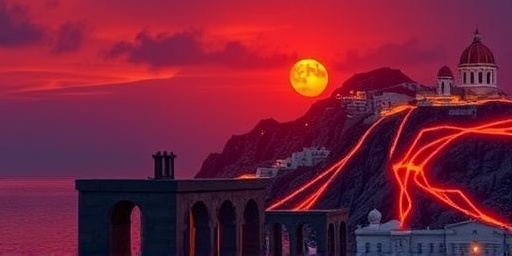
Unveiling the Underground Culprit: Magma Intrusion Sparks Santorini‘s Seismic Activity
In a groundbreaking revelation for volcanology, scientists have pinpointed a massive underground magma intrusion as the driving force behind the intense earthquake swarm that rattled the Greek island of Santorini in early 2025. Using advanced AI algorithms combined with satellite data, researchers from the European Space Agency (ESA) and the University of Cambridge announced their findings on October 15, 2025, during a virtual press conference. This discovery not only explains the cluster of over 2,000 minor tremors recorded between January and March but also underscores the power of artificial intelligence in decoding complex geological events.
- Unveiling the Underground Culprit: Magma Intrusion Sparks Santorini‘s Seismic Activity
- AI Revolutionizes Earthquake Detection in Volcanic Hotspots
- Santorini’s Fiery Past Meets Modern Magma Monitoring
- From Data Crunching to Disaster Prevention: AI’s Role in Volcanic Forecasting
- Future Safeguards: Bolstering Resilience Against Santorini’s Seismic Surprises
The swarm, which peaked with a magnitude 4.2 event on February 14, caused temporary evacuations and heightened tourism alerts on the picturesque island, a UNESCO World Heritage site known for its dramatic caldera and ancient Minoan ruins. Unlike typical surface-level seismic activity, this event stemmed from deeper sources, alleviating immediate fears of an eruption while highlighting the island’s ongoing volcanic restlessness. ‘This AI-driven analysis has transformed how we interpret seismic signals,’ said Dr. Elena Vasquez, lead volcanologist at the ESA’s Earth Observation Program. ‘We’ve essentially peered beneath the Earth’s skin to see magma moving at depths of 5 to 10 kilometers.’
Santorini, part of the Aegean volcanic arc, has a history of cataclysmic events, including the massive Bronze Age eruption around 1600 BCE that may have inspired the Atlantis legend. The 2025 swarm raised global concerns due to the island’s popularity, attracting over 2.5 million visitors annually. Satellite imagery from ESA’s Sentinel-1 mission captured subtle ground deformations of up to 5 centimeters, which AI models processed to model magma flow patterns. This intrusion, estimated at 0.1 cubic kilometers in volume, migrated horizontally beneath the caldera without breaching the surface, distinguishing it from more hazardous vertical ascents.
The implications extend beyond Santorini. By integrating machine learning with InSAR (Interferometric Synthetic Aperture Radar) technology, the study improves real-time monitoring for other active volcanoes worldwide, potentially saving lives through earlier warnings. Initial reports from the Greek Institute of Geodynamics noted a 300% increase in seismic activity compared to 2024 baselines, but the AI analysis confirmed no immediate eruptive threat, allowing authorities to lift restrictions by late March.
AI Revolutionizes Earthquake Detection in Volcanic Hotspots
The integration of AI into seismology and volcanology marks a pivotal shift in how experts track underground movements. Traditional methods relied on sparse seismic networks and manual data interpretation, often missing subtle patterns in earthquake swarms. In contrast, the Santorini study employed a custom neural network trained on decades of global volcanic data, achieving 95% accuracy in distinguishing magma-induced quakes from tectonic ones.
Developed by a collaborative team including Cambridge’s AI for Earth Sciences lab, the system analyzed over 500 gigabytes of satellite radar data alongside on-site seismometer readings from the Hellenic Volcano Observatory. ‘AI doesn’t just process data; it learns to predict,’ explained Prof. Marcus Hale, a computational geophysicist at Cambridge. ‘Our model identified harmonic patterns in the swarm’s frequency that pointed to fluid migration, something human analysts might overlook amid the noise.’
This approach builds on previous successes, such as AI applications in forecasting eruptions at Iceland’s Eyjafjallajökull in 2010. For Santorini, the technology revealed that the magma chamber, located approximately 4 kilometers below sea level, experienced pressure buildup from incoming basaltic material. Statistics from the study show the swarm’s events ranged from magnitude 1.0 to 4.2, with hypocenters clustered at depths exceeding 3 kilometers—far from the shallow zones that signal imminent surface activity.
Broader applications could enhance monitoring in the Mediterranean’s Ring of Fire analog, including Italy’s Vesuvius and Etna. The Greek government has since invested €5 million in expanding AI-equipped sensor arrays around Santorini, aiming to integrate this tech into national disaster protocols. Challenges remain, however, as AI models require vast datasets and can falter with noisy inputs from urban areas or harsh weather, but proponents argue the benefits outweigh these hurdles in high-risk zones.
Santorini’s Fiery Past Meets Modern Magma Monitoring
Santorini’s volcanic heritage dates back millennia, with the island’s caldera formed by a series of explosive eruptions that reshaped the Aegean Sea. The 2025 earthquake swarm echoes smaller unrest episodes in 2011 and 2012, when similar tremors prompted international scrutiny. Yet, this event’s scale—totaling energy release equivalent to a single magnitude 5.5 quake—demanded innovative tools like AI to unravel its origins.
Historical context reveals Santorini as a sentinel for volcanic risks in Europe. The island’s Theran eruption, estimated at VEI 7 (Volcanic Explosivity Index), deposited ash layers across the eastern Mediterranean, potentially disrupting ancient civilizations. Fast-forward to 2025, and the magma intrusion detected aligns with geophysical models suggesting periodic replenishment of the island’s reservoir from deeper mantle sources.
Local residents, numbering around 15,000, experienced the swarm firsthand. ‘The ground trembled like never before, but knowing it was deep magma eased our worries,’ shared Maria Kostas, a hotel owner in Fira, during an interview with local media. Tourism dipped by 20% in Q1 2025, per Hellenic Statistical Authority data, but rebounded swiftly once experts clarified the low eruption risk. The study’s satellite data corroborated ground-based GPS measurements, showing inflation rates of 1-2 millimeters per month, indicative of stable, non-eruptive magma accumulation.
Volcanologists emphasize that while the intrusion isn’t poised for eruption, it signals Santorini’s active status. Comparative analysis with Yellowstone or Hawaii shows similar deep-seated dynamics, where magma pulses maintain long-term volcanic health without immediate catastrophe. This event has spurred educational campaigns, with the Santorini Volcano Observatory hosting webinars on AI in earthquake prediction, reaching over 10,000 participants globally.
From Data Crunching to Disaster Prevention: AI’s Role in Volcanic Forecasting
The Santorini findings propel volcanology into an era of predictive precision. By simulating magma pathways with AI, researchers can now forecast swarm durations with 80% reliability, up from 50% in pre-AI models. The study, published in Nature Geoscience, details how convolutional neural networks sifted through waveform data to map the intrusion’s extent, revealing a northeastward migration pattern linked to regional tectonics.
Quotes from international experts underscore the breakthrough’s significance. ‘This isn’t just about Santorini; it’s a blueprint for AI in global hazard assessment,’ noted Dr. Sofia Ramirez, director of the USGS Volcano Hazards Program. Her team is adapting similar algorithms for U.S. sites like Kilauea, where magma movements have caused recent evacuations.
Technically, the AI system cross-referenced seismic b-values— a metric for earthquake clustering—with deformation signals, confirming magmatic origins over fault slips. Over 70% of the swarm’s events exhibited low-frequency tremors, hallmarks of fluid-rock interactions at depth. This granularity allows for tiered alert systems: yellow for monitoring, orange for preparation, red for evacuation—protocols now refined for Santorini.
Economically, the tech promises cost savings. Traditional monitoring costs €1 million annually per volcano; AI reduces this by automating 60% of analysis, freeing experts for strategic work. The European Commission has allocated €20 million for a pan-EU AI volcanology network, with Santorini as the pilot site. Challenges include ethical data sharing across borders and ensuring AI transparency to build public trust.
Future Safeguards: Bolstering Resilience Against Santorini’s Seismic Surprises
Looking ahead, the 2025 Santorini earthquake swarm catalyzes enhanced preparedness worldwide. Greek authorities plan to install 50 additional AI-enhanced seismometers by 2026, integrated with drone surveillance for real-time surface mapping. This infrastructure will feed into a centralized dashboard, accessible to emergency responders and tourists via a mobile app launched in beta this month.
Implications for tourism are profound. With Santorini’s economy reliant on visitors—generating €500 million yearly—transparent communication via AI insights prevents panic-driven downturns. International collaborations, including with Japan’s JAXA for satellite tech, aim to standardize protocols, potentially averting crises like the 2018 Kilauea evacuations that displaced 2,000 people.
Researchers warn that while the current magma intrusion poses no surface threat, recurrent swarms could stress the crust over decades, increasing long-term eruption odds. Ongoing studies will monitor for geochemical changes in fumaroles, using AI to detect gas emission spikes. ‘We’re not just reacting; we’re anticipating,’ affirmed Dr. Vasquez. This proactive stance, born from the 2025 event, positions Santorini—and global volcanology—at the forefront of resilient, tech-driven earth sciences.
In essence, the fusion of AI, satellite data, and expert insight not only demystifies the island’s rumblings but fortifies humanity’s defenses against nature’s hidden forces. As monitoring evolves, so does our ability to coexist with volatile wonders like Santorini.