
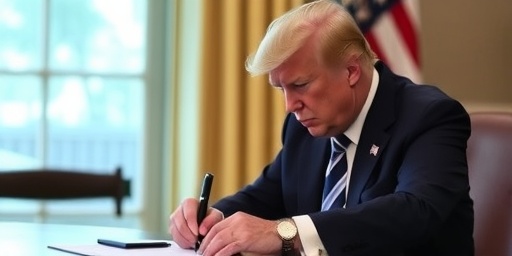
In a pivotal move for the nation’s technological future, President Donald Trump has signed a sweeping executive order on artificial intelligence (AI), directing federal agencies to prioritize AI innovation and streamline technology policy. The order, unveiled at a White House ceremony today, promises to inject billions in federal funding into AI research and deployment, aiming to cement the United States’ leadership in this rapidly evolving field amid global competition from China and Europe.
- Key Directives: Streamlining AI Governance and Ethical Standards
- Unlocking Federal Funding: Billions for AI Research and Infrastructure
- Industry Reactions: Tech Sector Cheers While Critics Raise Concerns
- Global Implications: Positioning U.S. AI Against International Rivals
- Future Horizons: AI’s Evolving Role in National Strategy
The directive comes at a time when AI is transforming industries from healthcare to defense, with the global AI market projected to reach $1.8 trillion by 2030 according to a recent McKinsey report. Trump’s action addresses long-standing concerns about bureaucratic hurdles slowing U.S. AI progress, potentially accelerating adoption across government operations and private sectors.
Key Directives: Streamlining AI Governance and Ethical Standards
At the heart of the executive order are mandates for federal agencies to overhaul their AI frameworks. The order requires the establishment of an AI Task Force within 90 days, led by the White House Office of Science and Technology Policy, to coordinate efforts across departments like Defense, Commerce, and Health and Human Services. This task force will develop uniform guidelines for AI procurement, ensuring that government contracts prioritize domestic developers and ethical AI practices.
One standout provision focuses on ethical AI deployment. Trump emphasized during the signing, “We must harness AI’s power while safeguarding American values—innovation without compromise.” The order bans the use of AI systems that discriminate based on race, gender, or other protected characteristics in federal decision-making, drawing from recent scandals involving biased algorithms in hiring and lending. It also allocates $500 million in initial federal funding for auditing existing AI tools in government use, with penalties for non-compliance.
Experts hail this as a proactive step. Dr. Fei-Fei Li, a prominent AI researcher at Stanford University, noted in an interview, “This order could prevent the pitfalls we’ve seen in unregulated AI rollouts, fostering trust in the technology.” The directives extend to data privacy, mandating that agencies adopt privacy-by-design principles in all new AI projects, aligning with broader technology policy shifts under the Trump administration.
Unlocking Federal Funding: Billions for AI Research and Infrastructure
A cornerstone of the executive order is its emphasis on ramping up federal funding for AI initiatives. The order directs the redirection of up to $2 billion from existing budgets toward AI-specific programs over the next fiscal year, including grants for universities, startups, and public-private partnerships. This funding will target critical areas such as machine learning for cybersecurity and AI-driven drug discovery, where the U.S. currently lags behind private sector investments.
According to the National Science Foundation, current federal AI spending hovers around $1.2 billion annually, but Trump’s order aims to double that by 2025 through efficiency measures and new appropriations. For instance, the Department of Energy will receive $800 million to build AI-optimized supercomputing facilities, enhancing simulations for climate modeling and energy efficiency. In healthcare, the order funnels $300 million to the National Institutes of Health for AI applications in diagnostics, potentially reducing misdiagnosis rates by 30%, as per a 2023 study in The Lancet.
Industry leaders are optimistic about the economic ripple effects. Tim Cook, CEO of Apple, stated via a company spokesperson, “This infusion of federal funding will supercharge AI development, creating jobs and spurring innovation that benefits every American.” Small businesses stand to gain too; the order includes tax incentives for AI startups partnering with federal agencies, projected to generate 50,000 new jobs in tech hubs like Silicon Valley and Austin by 2026, based on Brookings Institution estimates.
However, not all details are finalized. The order calls for a comprehensive funding roadmap by mid-2024, which will involve congressional input to avoid partisan gridlock. This builds on Trump’s previous technology policy wins, like the 2019 executive order on maintaining American leadership in AI, but scales up ambitions significantly.
Industry Reactions: Tech Sector Cheers While Critics Raise Concerns
The tech community has largely welcomed President Trump‘s executive order, viewing it as a much-needed boost to U.S. AI competitiveness. Elon Musk, CEO of Tesla and SpaceX, tweeted shortly after the signing: “A smart play for AI dominance—America first in the AI race.” Major players like Google and Microsoft, which have lobbied for clearer technology policy, praised the order’s focus on reducing regulatory red tape. Sundar Pichai, Google’s CEO, remarked, “This will enable faster deployment of AI solutions that solve real-world problems, from traffic optimization to personalized education.”
Yet, reactions are mixed. Civil liberties groups, including the Electronic Frontier Foundation, worry about the order’s defense applications. The directive expands AI use in national security, including autonomous drones and predictive policing, prompting ACLU executive director Anthony Romero to caution, “Without robust oversight, this could erode privacy rights and exacerbate biases in law enforcement.” Environmental advocates also flagged potential energy demands of AI data centers, estimating they could consume 8% of U.S. electricity by 2030 if unchecked.
On Capitol Hill, bipartisan support emerges. Senate Majority Leader Chuck Schumer called it “a bipartisan win for innovation,” while House Republican Leader Kevin McCarthy added, “Trump‘s vision ensures AI serves the people, not just big tech.” Still, Democrats push for more emphasis on workforce training, noting that AI could displace 85 million jobs globally by 2025, per World Economic Forum data. The order addresses this partially with $200 million for reskilling programs, but experts argue it’s insufficient for the scale of disruption.
Global Implications: Positioning U.S. AI Against International Rivals
President Trump‘s executive order arrives amid intensifying global AI competition. China, which invested $15 billion in AI last year according to the Center for Strategic and International Studies, poses the biggest threat. The U.S. order counters this by restricting export of sensitive AI technologies to adversarial nations and promoting alliances with allies like the UK and Japan through joint federal funding initiatives.
Under the new technology policy, the State Department will lead diplomatic efforts to establish international AI standards, preventing a fragmented global landscape. This includes $100 million for AI diplomacy programs, focusing on ethical exports and countering disinformation campaigns powered by foreign AI. A recent RAND Corporation report underscores the stakes: countries leading in AI could add $13 trillion to global GDP by 2030, with the U.S. risking second place without bold action.
Domestically, the order integrates AI into infrastructure projects, such as smart cities and autonomous vehicle testing. The Department of Transportation will allocate $400 million for AI-enhanced traffic systems, aiming to cut commute times by 20% in major metros. Internationally, it signals Trump‘s “America First” approach, prioritizing U.S. firms in global supply chains while fostering collaborations that benefit American workers.
Scholars like Erik Brynjolfsson from MIT predict transformative effects: “This executive order could accelerate AI’s productivity gains, potentially boosting U.S. GDP by 1-2% annually.” Challenges remain, including talent shortages— the U.S. produces only 10% of the world’s AI PhDs despite leading in publications—prompting calls for visa reforms to attract global experts.
Future Horizons: AI’s Evolving Role in National Strategy
Looking ahead, Trump‘s executive order sets the stage for AI to become a pillar of national strategy. Implementation will begin with pilot programs in 2024, testing AI in areas like disaster response and supply chain resilience. The order envisions a “AI Moonshot” initiative, akin to NASA’s Apollo program, to achieve breakthroughs in quantum AI and human-AI symbiosis by 2030.
Federal funding streams will evolve based on task force recommendations, potentially incorporating public feedback through online portals. This participatory element could democratize AI development, ensuring diverse voices shape technology policy. Economists forecast that sustained investment could create a $500 billion AI ecosystem in the U.S. by decade’s end, driving exports and innovation.
Yet, success hinges on adaptability. As AI advances, from generative models like GPT-4 to robotics, the administration must balance speed with safeguards. International forums, such as the upcoming G7 AI Summit, will test the order’s global resonance. Ultimately, this directive positions AI not just as a tool, but as a strategic asset for prosperity and security, urging all stakeholders to engage proactively in America’s AI era.