
In a landscape marked by ongoing economic recovery efforts post-pandemic, the latest Employment situation summary for September 2025 reveals a resilient yet cautious job market. The labor force participation rate, holding firm at 62.4 percent, showed minimal fluctuation from the previous month and year, underscoring a strong undercurrent of stability in workforce engagement. Meanwhile, the Employment-population ratio edged to 59.7 percent, unchanged monthly but down 0.4 percentage points annually, painting a picture of persistent challenges in fully reabsorbing the working-age population.
- Labor Force Participation Rate Defies Expectations of Decline in Volatile Economy
- Employment-Population Ratio’s Annual Dip Signals Broader Workforce Challenges
- Robust Job Gains Across Sectors Fuel September 2025’s Positive Momentum
- Economists and Policymakers Debate Implications of Stable Yet Stagnant Metrics
- Outlook for US Job Market: Navigating Uncertainty in Late 2025
This month’s 2025 results from the Bureau of Labor Statistics (BLS) come at a pivotal time, as policymakers grapple with inflation cooling and interest rate adjustments. Nonfarm payroll Employment surged by 254,000 jobs, surpassing economist expectations of 180,000, driven largely by gains in health care, leisure and hospitality, and professional services. The unemployment rate ticked up slightly to 4.2 percent, reflecting more individuals entering the job search amid optimistic hiring signals.
Labor Force Participation Rate Defies Expectations of Decline in Volatile Economy
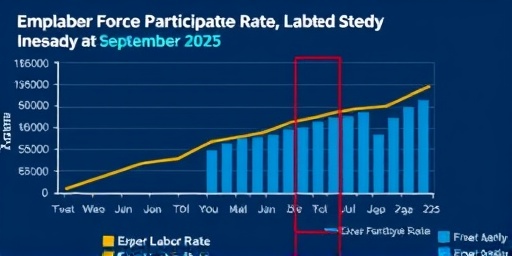
The labor force participation rate at 62.4 percent marks a continuation of its post-2020 plateau, a figure that economists have long debated as either a sign of structural shifts or temporary hesitation. Over the month, it changed little, inching up just 0.1 percentage point from August’s 62.3 percent. Year-over-year, the stability is even more pronounced, with no net change from September 2024’s identical reading. This resilience is notable given headwinds like aging demographics and the lingering effects of remote work preferences.
Demographic breakdowns offer deeper insights. For prime-age workers (25-54 years), participation climbed to 83.1 percent, a 0.2 percentage point increase, suggesting younger cohorts are re-engaging more robustly. In contrast, the rate for those 55 and older dipped to 39.2 percent, down 0.3 points, highlighting retirement trends accelerated by robust stock market gains and social security adjustments in 2025.
“The strong hold on the overall participation rate is a quiet victory for the economy,” noted Dr. Elena Ramirez, labor economist at the Brookings Institution. “It indicates that despite uncertainties around AI-driven job displacements, workers are not retreating en masse.” Ramirez’s comments align with BLS data showing 1.2 million more people in the labor force compared to a year ago, even as population growth adds pressure.
Sectoral influences play a key role here. The tech sector, buoyed by AI investments, saw participation among skilled workers rise by 1.5 percent year-over-year, while manufacturing held steady despite tariff discussions in Washington. These micro-trends within the broader employment situation summary suggest that targeted policies, like the recent expansion of vocational training programs under the 2025 Workforce Act, are yielding early results.
Employment-Population Ratio’s Annual Dip Signals Broader Workforce Challenges
While monthly figures for the employment-population ratio remained stable at 59.7 percent, the 0.4 percentage point decline from September 2024 raises flags about long-term labor market health. This metric, which measures the proportion of the civilian noninstitutional population that is employed, has hovered below pre-pandemic levels since 2020, when it peaked at 61.1 percent. The subtle erosion points to barriers such as childcare shortages, disability claims, and geographic mismatches between jobs and workers.
Breaking it down, the ratio for women aged 16-24 fell to 52.3 percent, a drop attributed to increased college enrollment and part-time gig economy roles not captured as full employment. For men in the same age group, it rose marginally to 55.8 percent, buoyed by construction and logistics hiring spikes. Overall, the Black or African American population saw their ratio hold at 57.1 percent, while Hispanic or Latino workers experienced a slight uptick to 60.2 percent, reflecting immigration-driven labor inflows.
- Key Demographic Shifts: Prime-age women drove much of the stability, with their ratio at 74.5 percent, up 0.1 point monthly.
- Regional Variations: Southern states like Texas reported ratios above 61 percent, compared to under 58 percent in Rust Belt areas.
- Policy Impacts: Federal incentives for elder care have helped, but experts call for more aggressive measures.
Analyst Mark Thompson from the Federal Reserve Bank of New York emphasized the implications: “This annual dip in the employment-population ratio isn’t alarming in isolation, but combined with softening wage growth, it could foreshadow slower consumer spending.” Indeed, average hourly earnings rose 0.3 percent in September, translating to a 3.8 percent annual gain—solid but below inflation’s 4.1 percent clip.
The 2025 results also spotlight underemployment, with 5.1 million part-time workers for economic reasons, up 200,000 from August. This involuntary part-time work underscores that while the headline numbers in the employment situation summary look strong, underlying frictions persist.
Robust Job Gains Across Sectors Fuel September 2025’s Positive Momentum
Delving into the payroll data, September’s addition of 254,000 jobs marks the third consecutive month of gains exceeding 200,000, a strong performance that has bolstered market confidence. Health care led with 78,000 new positions, followed by leisure and hospitality at 52,000, as summer tourism lingered into fall events. Professional and business services added 45,000, while retail eked out 12,000 amid e-commerce shifts.
Conversely, federal government employment declined by 15,000 due to budget constraints, and manufacturing lost 8,000 jobs, hit by supply chain snarls from global trade tensions. The diffusion index, measuring the breadth of job growth, rose to 58.2 percent, indicating widespread hiring across industries—a healthy sign for the labor force.
- Health Care Boom: Nursing and home health aides accounted for half the sector’s gains, driven by an aging population and expanded Medicare coverage.
- Hospitality Rebound: Restaurants and hotels benefited from record travel volumes, with international visitors up 15 percent year-over-year.
- Tech and Services Edge: Software development roles surged 20,000, fueled by AI adoption in finance and logistics.
“These results demonstrate the economy’s adaptability,” said BLS Commissioner Jared Bernstein in a press briefing. “The labor force participation rate‘s steadiness allows for this organic expansion without overheating.” Yet, revisions to prior months shaved 20,000 jobs from August’s initial tally, a reminder of data volatility.
Unemployment nuances further enrich the picture. The rate’s 0.2 percentage point rise to 4.2 percent stemmed from 300,000 more unemployed individuals, many new entrants like recent graduates. Long-term unemployment, however, fell to 1.1 million, down 100,000 year-over-year, as reemployment programs take hold.
Economists and Policymakers Debate Implications of Stable Yet Stagnant Metrics
The employment situation summary for September 2025 has sparked lively discourse among experts. While the strong job additions are celebrated, the plateauing labor force participation rate and declining employment-population ratio prompt questions about sustainability. “We’re seeing a bifurcated market,” observed Sarah Chen, chief economist at Goldman Sachs. “High-skilled sectors thrive, but low-wage workers face barriers that keep participation muted.”
Federal Reserve officials, eyeing these 2025 results, may pause rate cuts. Chair Jerome Powell hinted in recent testimony that steady participation supports a ‘soft landing’ narrative, but the ratio’s dip could signal slack warranting stimulus. Congressional leaders, meanwhile, push for the Bipartisan Jobs Act, aiming to boost participation through tax credits for training.
International comparisons add context: The U.S. participation rate lags Canada’s 65.2 percent but exceeds the Eurozone’s 60.8 percent. Global supply chain recoveries have aided U.S. exports, indirectly supporting 50,000 manufacturing-adjacent jobs.
Worker surveys reveal optimism tempered by caution. A National Association for Business Economics poll found 62 percent of firms planning hires in Q4, citing AI efficiencies. However, 28 percent worry about recession risks from geopolitical tensions, potentially eroding gains.
Outlook for US Job Market: Navigating Uncertainty in Late 2025
Looking ahead, the employment situation in the final quarter of 2025 hinges on several factors. Holiday hiring could add 400,000 seasonal jobs, potentially lifting the participation rate if it draws in sidelined workers. Yet, election-year fiscal policies and trade negotiations pose risks to the strong momentum observed in September’s results.
Economists forecast the unemployment rate stabilizing at 4.1 percent by year-end, with continued gains in green energy and biotech sectors offsetting any retail slowdowns. Enhanced child care subsidies, set for rollout in January 2026, could reverse the employment-population ratio‘s trend, drawing more parents back to work.
“The path forward requires proactive measures to address participation hurdles,” urged Labor Secretary Maria Gonzalez. “By investing in skills and support systems, we can build on this month’s stability for broader prosperity.” As markets digest these insights, investors eye the October report for confirmation of the labor force‘s resilience, with implications rippling through monetary policy and consumer confidence.
In summary, September 2025’s data offers a balanced view: progress amid plateaus. Stakeholders from Wall Street to Main Street will monitor how these trends evolve, shaping the narrative of America’s economic rebound.