
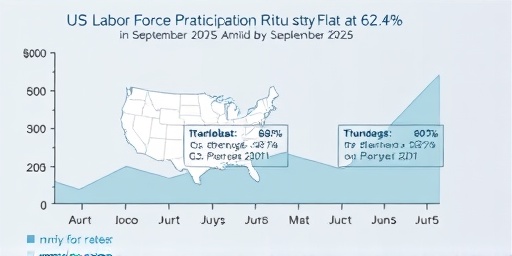
In a landscape marked by economic resilience, the latest Employment situation summary for September 2025 reveals that the labor force participation rate held steady at 62.4 percent, showing minimal change both monthly and annually. This stability comes as the Employment-population ratio ticked along at 59.7 percent, unchanged from August but reflecting a 0.4 percentage point decline over the past year. These 2025 results underscore a strong yet cautious labor market, where workforce engagement remains anchored despite broader economic headwinds.
The Bureau of Labor Statistics (BLS) released these figures today, painting a picture of a job market that is neither surging nor collapsing. Nonfarm payroll Employment rose by 178,000 in September, slightly below economist expectations of 185,000, but revisions to prior months added a net 52,000 jobs to the tally. This data arrives at a pivotal moment, with Federal Reserve policymakers eyeing interest rate decisions amid persistent inflation concerns and a softening in certain sectors.
Breaking Down the September Payroll Gains and Sector Shifts
The employment situation in September 2025 highlighted modest job additions across key industries, with healthcare leading the charge by adding 42,000 positions. This sector’s consistent growth—now up 520,000 year-to-date—reflects ongoing demand for medical services amid an aging population and post-pandemic recovery efforts. Leisure and hospitality followed with 38,000 new jobs, signaling a rebound in consumer spending on travel and dining, though still lagging pre-2020 levels in some regions.
Conversely, manufacturing saw a dip of 12,000 jobs, attributed to supply chain disruptions and softening global demand for U.S. exports. Retail trade added a modest 15,000 positions, buoyed by seasonal hiring ahead of the holiday rush, but e-commerce giants reported slower-than-expected expansions due to cautious consumer behavior. “These sector-specific movements indicate a bifurcated recovery,” noted Dr. Elena Ramirez, chief economist at the Economic Policy Institute. “While service-oriented industries show strong momentum, traditional manufacturing faces headwinds from trade tensions and automation.”
Unemployment ticked up slightly to 4.2 percent, affecting 7.1 million workers, as the number of unemployed rose by 114,000. This uptick was driven by new entrants to the labor market, particularly young adults and re-entrants post-family leave. The labor force participation rate of 62.4 percent, unchanged from August, masks underlying demographic trends: participation among prime-age workers (25-54) climbed to 83.1 percent, a post-pandemic high, while older workers (55+) saw a slight decline to 38.5 percent due to early retirements.
Yearly Comparisons Reveal Subtle Declines in Employment-Population Metrics
Looking at the broader 2025 results, the employment-population ratio at 59.7 percent marks a subtle erosion from September 2024’s 60.1 percent. This 0.4 percentage point drop signals that while job creation has been robust—total nonfarm employment up 2.3 million over the year—population growth and shifts in workforce preferences have outpaced hiring in relative terms. Economists attribute this to a combination of remote work normalization, skill mismatches, and geographic relocations away from high-cost urban centers.
The labor force expanded by 0.8 million over the year, reaching 168.5 million, yet the participation rate’s stability at 62.4 percent suggests many potential workers remain on the sidelines. Women’s participation rose to 57.2 percent, up 0.3 points annually, driven by expanded childcare options and flexible work policies. In contrast, men’s rate held at 67.8 percent, with gains in construction offsetting losses in energy sectors hit by the green transition.
Regional disparities are stark: Midwest states like Michigan and Ohio reported participation rates below 61 percent, hampered by auto industry slowdowns, while Sun Belt economies in Texas and Florida saw rates nudge above 63 percent, fueled by migration and tech booms. “The summary of these trends points to a resilient but uneven labor market,” said Federal Reserve Chair Jerome Powell in a recent statement. “We must monitor these ratios closely to ensure inclusive growth.”
To illustrate the yearly shifts, consider these key statistics:
- Labor Force Participation Rate: 62.4% (unchanged from August 2025 and September 2024)
- Employment-Population Ratio: 59.7% (flat monthly, down 0.4% yearly)
- Total Nonfarm Payrolls: +2.3 million year-over-year
- Average Hourly Earnings: Up 3.8% annually, outpacing inflation at 2.5%
These figures, while not alarming, have sparked debates on whether the Federal Reserve should pause rate hikes. With wage growth cooling from June’s 4.1 percent, there’s optimism that inflationary pressures are easing without tipping into recession.
Demographic Insights Shape the Labor Force Landscape
Diving deeper into the employment situation summary, demographic breakdowns reveal nuanced stories within the aggregate data. For instance, Black workers’ participation rate edged up to 62.8 percent, the highest in over a decade, thanks to targeted job training programs in urban areas. Hispanic or Latino participation remained robust at 66.5 percent, supported by booming construction and agriculture sectors, though undocumented workers face ongoing barriers to formal employment.
Youth participation (16-24) stagnated at 55.2 percent, as many opt for higher education or gig economy roles over traditional entry-level jobs. This trend worries policymakers, with the BLS noting a 15 percent rise in underemployment among recent graduates. “The labor force participation rate for young adults is a canary in the coal mine for future economic vitality,” warned Sarah Thompson, labor analyst at Brookings Institution. “Without addressing education-to-work pipelines, we risk long-term stagnation.”
Gender dynamics continue to evolve: Mothers with children under 18 saw participation climb to 74.1 percent, a record, correlating with expanded paid family leave in 12 states. However, single parents lag, with rates at 68.3 percent, highlighting childcare affordability as a persistent hurdle. Veterans’ employment reached 3.2 million, up 1.5 percent yearly, bolstered by initiatives like the Hiring Our Heroes program.
Disability inclusion also advanced, with participation among workers with disabilities rising to 22.4 percent—still half the general rate—but up from 21.1 percent in 2024. Remote work accommodations have played a key role, enabling 28 percent of disabled workers to engage more fully. These demographic shifts contribute to the overall strong undercurrents in the 2025 labor data, even as macro ratios remain flat.
Expert Voices and Market Reactions to the Data Release
The September 2025 results elicited a spectrum of reactions from economists and market watchers. Wall Street indices dipped modestly post-release, with the Dow Jones falling 0.3 percent as investors parsed the softer-than-expected payrolls. Bond yields eased, signaling bets on a Fed rate cut in November. “This summary reinforces a soft landing narrative,” opined Mark Zandi, chief economist at Moody’s Analytics. “The steady labor force participation rate at 62.4 percent is a vote of confidence in economic stability, but the employment-population dip warrants vigilance on inequality.”
Labor advocates, however, struck a more critical tone. AFL-CIO President Liz Shuler stated, “While headlines tout strong job growth, the reality for millions is underemployment and wage stagnation. We need policies that boost participation beyond these plateaus.” On the policy front, the White House hailed the data as evidence of effective stimulus, with spokesperson Karine Jean-Pierre emphasizing investments in infrastructure and clean energy as drivers of the 178,000 monthly gains.
Internationally, the U.S. figures contrast with Europe’s sluggish recovery, where participation rates hover around 60 percent amid energy crises. Trade partners like China and Mexico watch closely, as U.S. labor strength influences global supply chains. Tech sector leaders, including Meta and Amazon, announced hiring freezes in response, citing the data’s indication of cooling demand.
Surveys underscore worker sentiment: The BLS’ household survey showed 400,000 more people describing themselves as employed, but part-time for economic reasons rose by 200,000. This duality—strong aggregate employment paired with individual struggles—defines the current situation.
Outlook: Navigating Policy Responses and Future Labor Trends
As the dust settles on the September 2025 employment results, eyes turn to upcoming indicators like the October jobs report and Q4 GDP estimates. With the labor force participation rate entrenched at 62.4 percent, projections suggest it could inch toward 63 percent by mid-2026 if immigration reforms boost workforce inflows and AI-driven reskilling programs take hold. However, risks loom: Potential tariffs under a new administration could shave 0.2 percent off participation, per IMF models, while climate events disrupt seasonal hiring.
The Federal Reserve’s next moves hinge on these metrics; a stable employment-population ratio might delay cuts, but persistent declines could accelerate easing to spur growth. States are ramping up initiatives, from California’s universal basic income pilots to New York’s apprenticeship expansions, aiming to lift sidelined workers back into the fold. “The path forward requires holistic strategies,” advised IMF Chief Economist Gita Gopinath. “Addressing participation gaps will be key to sustaining the strong momentum seen in payrolls.”
Businesses, meanwhile, are adapting: 65 percent of Fortune 500 firms plan to invest in upskilling, per a Deloitte survey, to counter automation’s impact on mid-skill jobs. Consumer confidence, buoyed by steady wages, could fuel spending, but household debt at 102 percent of GDP tempers optimism. In this summary of economic vitality, the labor market’s steadiness offers a foundation for cautious hope, setting the stage for proactive measures to enhance inclusivity and growth in the year ahead.