

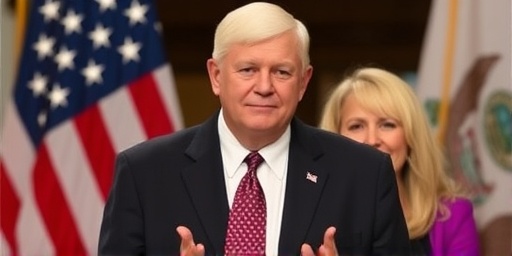
In a significant escalation of financial scrutiny on public officials, the United States government has filed a lawsuit against West Virginia Senator Jim Justice and his wife, Cathy Justice, seeking $5.1 million in unpaid taxes that date back to 2009. This action comes amid a series of mounting legal woes for the prominent businessman-turned-politician, whose vast business empire has long been a source of both admiration and controversy. The case highlights ongoing challenges in tax enforcement and raises questions about the integrity of fiscal responsibilities among America’s elite, potentially rippling through the broader United States economy.
- Origins of the Tax Dispute: Unpaid Liabilities from Business Ventures
- Justice’s Defense: Claims of Aggressive Auditing and Political Motivation
- Mounting Legal Woes: A Timeline of Justice’s Financial Scrutiny
- Economic Ramifications: How Tax Evasion Cases Strain National Finances
- Looking Ahead: Potential Outcomes and Political Fallout
The lawsuit, filed in federal court in Charleston, West Virginia, accuses the Justices of failing to pay income taxes on substantial earnings from their coal mining and resort operations. According to court documents, the unpaid taxes stem from underreported income and improper deductions claimed over more than a decade. This development not only threatens Justice’s personal finances but also underscores the critical role that tax compliance plays in sustaining the United States economy, where every dollar in revenue funds essential public services and infrastructure.
Origins of the Tax Dispute: Unpaid Liabilities from Business Ventures
The roots of this legal battle trace back to Senator Jim Justice’s expansive business portfolio, which includes ownership of the Greenbrier Resort and numerous coal companies operating across the Appalachian region. Justice, a billionaire with a net worth estimated at over $1.2 billion by Forbes, built his fortune through aggressive expansion in energy and hospitality sectors during the early 2000s. However, federal investigators allege that between 2009 and 2018, the couple evaded taxes on millions in profits by exploiting loopholes in reporting mechanisms.
Court filings detail specific instances where the Justices claimed excessive business expense deductions for personal luxuries, including private jet travel and lavish renovations at their properties. ‘The United States economy relies on fair tax contributions from all citizens, especially those in positions of power,’ stated IRS spokesperson Maria Gonzalez in a press release. ‘This lawsuit serves as a reminder that no one is above the law.’ The $5.1 million figure represents principal taxes owed plus accrued interest and penalties, calculated at a rate of 5% per annum under federal guidelines.
Historical context reveals that Justice’s companies have faced similar financial entanglements before. In 2017, one of his coal firms, Bluestone Industries, filed for bankruptcy amid $300 million in debts, partly attributed to environmental fines and operational setbacks. Tax experts note that such corporate restructurings often complicate personal tax filings, leading to disputes like this one. According to a 2022 report by the Tax Policy Center, high-income individuals in extractive industries account for nearly 15% of all IRS audit disputes, a statistic that places Justice squarely in the spotlight.
Justice’s Defense: Claims of Aggressive Auditing and Political Motivation
Senator Justice, a Republican who assumed office in 2021 after serving as West Virginia’s governor from 2017 to 2021, has vehemently denied the allegations. In a statement released from his Charleston office, he described the lawsuit as ‘a politically motivated witch hunt designed to derail my service to the people of West Virginia.’ His wife, Cathy, echoed these sentiments, calling the claims ‘baseless and hurtful to our family’s legacy.’
Legal representatives for the Justices argue that the tax issues arose from complex accounting practices common in the coal industry, where fluctuating commodity prices and regulatory changes create volatile income streams. ‘We’ve paid our fair share and then some,’ Justice told reporters during a brief press conference outside the state capitol. ‘This is nothing more than the federal government squeezing hardworking Americans.’ Sources close to the family indicate they plan to countersue, alleging overzealous auditing by the IRS that borders on harassment.
The timing of the lawsuit is particularly poignant, coinciding with Justice’s re-election campaign for the 2024 Senate term. Political analysts suggest that while the case could erode his support base—polls from Emerson College show his approval rating dipping to 48% among independents—it might also rally conservative voters wary of federal overreach. ‘In an era of economic uncertainty, stories like this fuel distrust in institutions,’ commented Dr. Elena Ramirez, a professor of public policy at George Washington University.
Mounting Legal Woes: A Timeline of Justice’s Financial Scrutiny
This tax suit is just the latest in a string of legal challenges plaguing Senator Justice and his enterprises. As early as 2012, the U.S. Department of Justice sued several of his coal companies for violations of the Clean Water Act, resulting in $5 million in settlements and mandated environmental upgrades. In 2019, amid his gubernatorial tenure, Justice faced a $4.5 million judgment from a lender over unpaid loans tied to his resort developments.
More recently, in 2023, the Securities and Exchange Commission launched an investigation into potential insider trading involving Justice’s stock sales in energy firms, though no charges have been filed to date. These cumulative issues paint a picture of a tycoon whose risk-taking business style has spilled over into his public life. A review of public records shows that between 2009 and 2023, Justice’s entities have been involved in over 20 lawsuits, with liabilities totaling more than $50 million.
From an economic perspective, these entanglements highlight vulnerabilities in the United States economy’s reliance on fossil fuel magnates. Coal production, a cornerstone of West Virginia’s GDP contributing $8 billion annually, has declined 40% since 2009 due to the shift toward renewables, per U.S. Energy Information Administration data. Justice’s troubles could exacerbate job losses in the sector, with 5,000 positions already shed in the state over the past five years, indirectly straining tax revenues and economic stability.
- Key Milestones in Justice’s Legal History:
- 2009-2018: Alleged tax underpayments accumulate to $5.1 million.
- 2012: Environmental lawsuit settlement for $5 million.
- 2017: Bluestone bankruptcy filing amid $300 million debts.
- 2019: Lender judgment of $4.5 million.
- 2023: Ongoing SEC probe into trading activities.
Experts like those at the Brookings Institution warn that prolonged litigation could force asset sales, further destabilizing local economies dependent on Justice’s operations.
Economic Ramifications: How Tax Evasion Cases Strain National Finances
Beyond the personal stakes, the Justice lawsuit illuminates broader fissures in the United States economy’s fiscal framework. The IRS estimates that the tax gap—the difference between taxes owed and collected—reaches $600 billion annually, with high-wealth non-compliance accounting for $163 billion of that figure. Cases like this one, where public figures are sued for unpaid taxes, serve as deterrents but also reveal enforcement limitations; only 1.6% of millionaires were audited in 2022, down from 8% a decade earlier due to budget cuts.
In West Virginia, where median household income lags at $48,000 compared to the national $68,000, the irony of a senator’s tax woes is stark. The state’s economy, heavily reliant on federal funding for 40% of its budget, suffers when high-profile evasions go unchecked, potentially leading to reduced services in education and healthcare. ‘Every unpaid tax dollar dating back years weakens our collective economic foundation,’ noted fiscal analyst Tom Hargrove in an op-ed for The Wall Street Journal.
Moreover, this case intersects with national debates on tax reform. With the United States economy grappling with 3.8% inflation and a $34 trillion national debt, proponents of stricter enforcement argue that pursuing wealthy defaulters could generate billions in revenue. A 2023 study by the Institute on Taxation and Economic Policy projects that closing loopholes for the top 1% could add $1.3 trillion to federal coffers over a decade, bolstering infrastructure and social programs.
Stakeholders in the business community have mixed reactions. The U.S. Chamber of Commerce issued a statement emphasizing the need for ‘clear tax guidelines to avoid such disputes,’ while environmental groups like the Sierra Club see it as an opportunity to push for diversification away from coal-dependent fortunes.
Looking Ahead: Potential Outcomes and Political Fallout
As the lawsuit progresses, Senator Justice faces a pivotal crossroads that could redefine his career and influence West Virginia’s economic trajectory. If the court rules in favor of the government, the $5.1 million judgment—potentially escalating with additional penalties—might necessitate liquidating assets, including stakes in the iconic Greenbrier Resort, which employs 1,200 people and generates $100 million in annual revenue.
Legal precedents suggest a drawn-out battle; similar high-profile tax cases, such as those against former Illinois Governor Rod Blagojevich, lasted years and ended in convictions. Justice’s team has motioned for summary judgment, but analysts predict a trial could commence by mid-2025, coinciding with midterm election cycles.
On the economic front, resolution of this case might bolster IRS credibility and encourage voluntary compliance among the ultra-wealthy, injecting vital funds into the United States economy at a time when recession fears loom with GDP growth projected at just 1.5% for 2024 by the Federal Reserve. For West Virginia voters, the outcome will test loyalties: Will Justice’s populist appeal withstand the scrutiny, or will it pave the way for challengers promising fiscal transparency?
Ultimately, this saga reinforces the interconnectedness of personal accountability and national prosperity. As investigations continue, the eyes of the nation—and the economy—remain fixed on Charleston, where justice, both literal and figurative, hangs in the balance.