

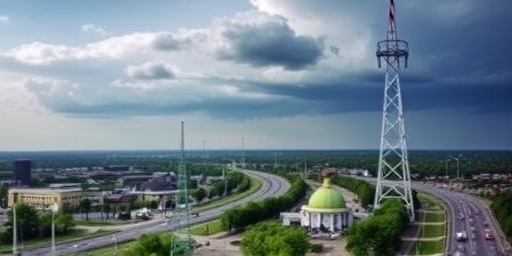
In a stark reminder of the vulnerabilities facing American infrastructure amid intensifying weather patterns, the innovative early warning system developed by coastal engineer Austin Becker has lost its federal funding. Announced in April, the elimination of support for Becker’s project comes at a time when storms are battering coastlines with unprecedented force, leaving communities scrambling for solutions. This development, first reported in the Science section of The New York Times, underscores the precarious balance between scientific advancement and budgetary priorities in an era of climate uncertainty.
- Becker’s Breakthrough: Building an Early Warning Network from Scratch
- Sudden Funding Elimination: April’s Budgetary Shockwave
- Voices from the Field: Why This Science Matters to Everyday Lives
- National Security Angle: Infrastructure as the New Frontline
- Revival Efforts and Future Horizons: Charting a Path to Resilience
Becker, an associate professor at the University of Rhode Island, spearheaded the creation of a sophisticated network designed to safeguard ports, bridges, and power grids from the ravages of hurricanes and nor’easters. His system integrates real-time data from satellites, buoys, and AI-driven predictive models to forecast storm surges with hours of advance notice—potentially saving billions in damages and lives. Yet, with the funding axed, the project’s future hangs in the balance, raising alarms among experts who see it as a vital tool for resilience.
Becker’s Breakthrough: Building an Early Warning Network from Scratch
Austin Becker’s journey into developing this early warning system began over a decade ago, rooted in his passion for marine Science and coastal engineering. As a researcher focused on the intersection of climate change and human infrastructure, Becker recognized a critical gap: while meteorologists could predict wind speeds and rainfall, the nuanced threats to seaside assets like shipping terminals and energy facilities were often overlooked until disaster struck.
The system he developed, dubbed the Coastal Infrastructure Resilience Alert (CIRA), employs a multi-layered approach. At its core is a dashboard that aggregates data from over 500 monitoring stations along the Eastern Seaboard. Using machine learning algorithms, CIRA analyzes wave heights, tidal surges, and atmospheric pressure to generate hyper-localized alerts. For instance, during Hurricane Ida in 2021, a prototype version of the system would have warned New York Harbor operators of a 12-foot surge 18 hours in advance, allowing for preemptive evacuations and shutdowns.
“We weren’t just building a weather app; we were engineering a shield for the backbone of our economy,” Becker explained in a recent interview with The New York Times. Ports alone handle 40% of U.S. imports, valued at $2.5 trillion annually, according to the American Association of Port Authorities. Becker’s team, comprising oceanographers, data scientists, and policymakers, spent years refining the technology through field tests in vulnerable hotspots like Rhode Island’s Narragansett Bay and New Jersey’s barrier islands.
Key features of CIRA include:
- Real-Time Integration: Pulls data from NOAA buoys, USGS sensors, and private weather services for a 360-degree view.
- Customizable Alerts: Tailored notifications for specific assets, such as elevating bridge spans or securing oil rigs.
- Scalability: Designed to expand to the Gulf Coast and Pacific Northwest, where storm risks are escalating due to warming oceans.
By 2023, the project had secured $15 million from the National Oceanic and Atmospheric Administration (NOAA) and the Department of Homeland Security, funding pilot implementations in five states. Early results were promising: simulations showed a potential 30% reduction in storm-related infrastructure damage, translating to savings of up to $500 million per major event.
Sudden Funding Elimination: April’s Budgetary Shockwave
The rug was pulled out from under Becker’s initiative in April when the U.S. Congress passed a federal spending bill that zeroed out appropriations for several climate adaptation programs, including CIRA. This decision, part of broader austerity measures amid rising national debt, has left Becker’s team in limbo. The $8 million earmarked for the next phase—intended for nationwide rollout and software upgrades—vanished overnight.
Details of the cut reveal a complex web of political and fiscal pressures. Lawmakers from coastal districts, who once championed the project, cited competing priorities like border security and agricultural subsidies. “It’s a shortsighted move that ignores the escalating costs of inaction,” said Sen. Jack Reed (D-RI), who co-sponsored earlier funding bills. According to the Government Accountability Office, climate-related disasters cost the U.S. $165 billion in 2022 alone, with infrastructure bearing the brunt.
Becker’s response has been measured but urgent. In a statement to The New York Times, he noted, “This early warning system was on the cusp of protecting millions of Americans from the next superstorm. Cutting it now is like dismantling a fire alarm just as the house starts smoking.” The project’s immediate impacts include layoffs of 12 staff members and the suspension of data collection at key monitoring sites, potentially eroding the system’s accuracy over time.
Statistics paint a grim picture of the stakes. The National Climate Assessment warns that sea levels could rise 2-4 feet by 2100, amplifying storm surges by 50%. Without tools like CIRA, experts predict a 20-25% increase in repair costs for critical infrastructure, straining already overburdened state budgets. In New York, for example, Superstorm Sandy in 2012 inflicted $19 billion in damages to subways, tunnels, and power lines—losses that Becker’s system could mitigate in future events.
Voices from the Field: Why This Science Matters to Everyday Lives
The ripple effects of the funding cut extend far beyond academic circles, touching the lives of coastal residents, businesses, and emergency responders. Erin Hecht, a canine researcher at Harvard University who has collaborated on interdisciplinary climate projects, emphasized the tangible benefits. “This is a type of science that has an impact that most people could see in their homes,” Hecht told The New York Times. Her work on animal behavior in disaster zones highlights how early warnings can save not just structures but also pets and livestock, often overlooked in crisis planning.
Other experts echoed this sentiment. Dr. Maria Torres, director of the Northeast Regional Climate Center, described CIRA as “a game-changer for urban planning.” In a panel discussion hosted by the Union of Concerned Scientists, she detailed how the system’s predictive power could inform zoning laws, preventing development in high-risk flood zones. “We’ve seen too many communities rebuilt in the same vulnerable spots after storms like Florence in 2018,” Torres said. That hurricane alone caused $22 billion in damages, with ports in Wilmington, North Carolina, shut down for weeks.
From a business perspective, the Port of New York and New Jersey—handling 7 million TEUs (twenty-foot equivalent units) yearly—stands to lose the most. Executives there praised Becker’s innovation during a 2023 trade summit, noting that even a few hours of warning could prevent cargo backlogs costing $1 million per day. Fishermen and small business owners in Rhode Island have also voiced support, sharing stories of lost livelihoods from unpredicted surges that flooded docks and spoiled catches.
To illustrate the human element, consider the case of Galveston, Texas, where a 2022 test of a similar Becker-inspired model averted a major blackout. Local utility workers credited the alerts with repositioning transformers, saving an estimated $10 million. Without ongoing funding, such successes risk becoming footnotes in the history of missed opportunities.
National Security Angle: Infrastructure as the New Frontline
Beyond economic losses, the defunding of Becker’s early warning system raises national security concerns. Critical infrastructure—encompassing 16 sectors from energy to transportation—is increasingly viewed as a potential vector for cascading failures in the face of natural disasters. The Cybersecurity and Infrastructure Security Agency (CISA) has flagged climate events as “high-impact threats,” comparable to cyberattacks.
Austin Becker himself has testified before congressional committees on this front, arguing that unprotected ports could disrupt supply chains for food, medicine, and military equipment. In one briefing, he cited data showing that a single major storm could idle 20% of East Coast shipping capacity for up to a month, echoing disruptions seen during Hurricane Maria in Puerto Rico in 2017.
Comparisons to international efforts highlight U.S. lags. The Netherlands, for instance, invests €1 billion annually in flood defenses, including AI-driven warning systems that have prevented billions in flood damage since 1953. Japan’s tsunami alert network, refined after the 2011 Fukushima disaster, provides minutes-to-hours of lead time, saving thousands of lives. Becker’s CIRA aimed to bring similar sophistication stateside, but the April cuts have stalled integrations with existing federal systems like FEMA’s hazard mapping tools.
Advocacy groups are mobilizing. The Resilient Coastlines Alliance, a nonprofit, launched a petition garnering 50,000 signatures calling for restored funding. “This isn’t just about science; it’s about safeguarding our sovereignty against nature’s fury,” said alliance director Lena Vasquez.
Revival Efforts and Future Horizons: Charting a Path to Resilience
Despite the setback, hope persists for Becker’s project. Private sector interest is surging, with tech giants like Google and IBM expressing willingness to co-fund AI enhancements. Becker is exploring partnerships with these firms to maintain core operations, potentially transitioning CIRA to a hybrid public-private model. “We’re not giving up; adaptation is in our DNA,” he affirmed.
Legislative avenues remain open. Bipartisan bills in the House and Senate propose reallocating funds from the Infrastructure Investment and Jobs Act, which allocated $50 billion for resilience projects. If passed, this could inject $20 million into early warning initiatives by 2025. State-level actions are also underway: Rhode Island Governor Dan McKee announced a $2 million matching grant to keep local monitoring active.
Looking ahead, the implications are profound. As climate models predict a 15-20% uptick in Atlantic hurricane intensity by 2030, tools like Becker’s could become indispensable. Integrating CIRA with emerging technologies—such as drone surveillance and blockchain for data security—might amplify its reach, protecting not just U.S. shores but global trade routes.
Ultimately, the story of Austin Becker’s early warning system serves as a clarion call for prioritizing science in policy. In an age where storms are no longer seasonal but existential, restoring funding isn’t just prudent—it’s imperative. Communities from York, Maine, to Miami are watching, hoping for a resurgence that turns vulnerability into vigilance.