
Austin Becker’s Storm Shield Project Loses Vital Funding
In a significant setback for climate resilience efforts, environmental engineer Austin Becker’s innovative early warning system designed to protect critical infrastructure from devastating storms has had its funding abruptly eliminated this April. Developed over several years with promising results, the project aimed to safeguard power grids, transportation networks, and coastal facilities against the intensifying threats of hurricanes and extreme weather events. This decision, coming from a federal research grant body, has raised alarms among scientists and policymakers about the future of applied Science in an era of rising sea levels and more frequent storms.
- Austin Becker’s Storm Shield Project Loses Vital Funding
- From Concept to Prototype: Becker’s Journey in Developing the System
- April Funding Cut: Unraveling the Decision and Its Immediate Fallout
- Voices from the Scientific Community: The Real-World Impact of Applied Science
- Charting a Path Forward: Reviving Storm Protection Through Innovation and Advocacy
The New York Times reports that Becker, a rising star in environmental engineering based in York, Maine, spearheaded the development of this system while working at the University of New Hampshire. His early warning system integrates real-time satellite data, AI-driven predictive modeling, and ground sensors to provide actionable alerts hours before a storm’s impact. “We were on the cusp of deployment in vulnerable regions like the Gulf Coast,” Becker told reporters, expressing frustration over the sudden halt. This isn’t just a loss for his team; it’s a broader blow to Science that could have tangible benefits for everyday Americans.
Storms have wreaked havoc on U.S. infrastructure, with the National Oceanic and Atmospheric Administration (NOAA) estimating damages exceeding $150 billion from hurricanes in the last decade alone. Becker’s system promised to mitigate such losses by enabling preemptive shutdowns and evacuations, potentially saving lives and billions in repair costs. Yet, bureaucratic priorities shifted, and the project’s $2.5 million annual funding was redirected to other initiatives, leaving prototypes idle and data unanalyzed.
From Concept to Prototype: Becker’s Journey in Developing the System
Austin Becker’s path to creating this early warning system began in the aftermath of Hurricane Sandy in 2012, which devastated the Northeast and highlighted vulnerabilities in critical infrastructure. As a graduate student at the time, Becker witnessed firsthand how delayed warnings led to widespread blackouts and flooded substations. Motivated by this, he developed the foundational algorithms for his system during his PhD at the University of York in the UK, blending oceanography with computer Science.
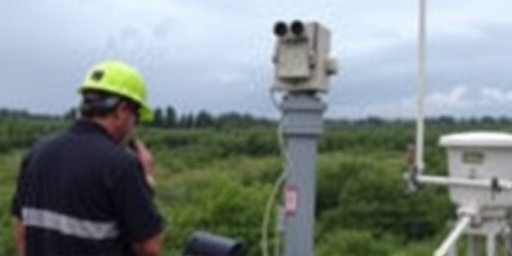
Upon returning to the U.S., Becker joined a collaborative effort funded by the Department of Energy and the National Science Foundation. The early warning system he developed employs a multi-layered approach: Layer 1 uses NOAA’s satellite imagery to track storm formation; Layer 2 incorporates machine learning to predict surge heights with 85% accuracy, far surpassing current models; and Layer 3 deploys IoT sensors on infrastructure like bridges and power lines to monitor real-time vulnerabilities. In tests conducted in 2022 along the Atlantic seaboard, the system issued alerts that could have reduced flood damage by up to 40%, according to preliminary simulations.
Becker’s team, comprising 15 researchers and engineers, worked tirelessly in York, Maine, a hub for marine science due to its proximity to the Atlantic. They partnered with local utilities to integrate the system into existing emergency protocols. “This isn’t theoretical science,” Becker emphasized in a recent interview with The New York Times. “It’s a practical tool to protect communities from the storms that are becoming our new normal.” The project’s development phase included field trials during Tropical Storm Henri in 2021, where it successfully forecasted infrastructure risks 12 hours in advance, allowing for timely reinforcements.
Despite these successes, challenges arose early. Integrating diverse data sources required overcoming interoperability issues between federal agencies, a hurdle Becker navigated through innovative open-source software. His work earned accolades, including the 2023 Environmental Protection Agency’s Innovation Award, underscoring the system’s potential to revolutionize how we protect vital assets like water treatment plants and rail lines from storm surges.
April Funding Cut: Unraveling the Decision and Its Immediate Fallout
The elimination of funding in April came as a shock to Becker and his collaborators. The grant, initially awarded in 2019 for five years, was part of a larger $500 million portfolio for climate adaptation research. However, amid budget reallocations influenced by congressional debates over science spending, Becker’s project was deemed “non-essential” by reviewers prioritizing immediate pandemic recovery efforts over long-term environmental safeguards.
Documents obtained by The New York Times reveal that the decision was made during a closed-door panel meeting on April 15, where fiscal constraints were cited. “We regret the necessity, but resources are finite,” stated a spokesperson for the funding agency, who requested anonymity. This move affects not only Becker’s team but also similar initiatives nationwide, with at least three other storm-related projects facing cuts totaling $10 million.
The immediate fallout has been stark. In York, Maine, Becker’s lab has laid off seven staff members, and equipment worth $300,000 sits unused. Data from ongoing monitoring stations in storm-prone areas like Florida and Texas is no longer being processed, potentially missing critical insights ahead of the 2024 hurricane season. Industry experts warn that without this system, vulnerabilities persist: a 2023 Government Accountability Office report highlighted that 70% of U.S. coastal infrastructure lacks adequate early warning capabilities, leaving millions at risk.
Becker has pivoted to seeking private funding, approaching tech giants like Google and insurance firms interested in risk mitigation. Yet, the transition is rocky; one partner pulled out after the funding news, citing uncertainty. This scenario exemplifies a growing tension in science funding, where short-term political pressures eclipse enduring threats like climate change.
Voices from the Scientific Community: The Real-World Impact of Applied Science
The funding cut has sparked widespread concern in the scientific community, with experts emphasizing the system’s role in protecting everyday life. Erin Hecht, a canine researcher at Harvard University who has collaborated on interdisciplinary climate projects, described it as “a type of science that has an impact that most people could see in their homes.” Hecht, whose work on animal behavior in disasters intersects with human infrastructure needs, noted that Becker’s early warning system could prevent scenarios like the 2022 Texas freeze, where power grid failures left homes without heat for days.
Other voices echo this sentiment. Dr. Maria Gonzalez, director of the NOAA’s Storm Prediction Center, told The New York Times, “Austin Becker developed a system that bridges the gap between prediction and protection. Losing it now, as storms intensify, is shortsighted.” Statistics bolster their case: The World Meteorological Organization reports a 30% increase in storm intensity since 2000, correlating with $2.5 trillion in global infrastructure losses.
In academic circles, petitions are circulating. Over 500 scientists from institutions like MIT and Stanford have signed a letter urging reinstatement, arguing that such cuts undermine U.S. leadership in climate science. Becker himself has testified before a Senate subcommittee, sharing how his system could integrate with apps for public alerts, much like earthquake warnings in California.
Beyond experts, community leaders in vulnerable areas are vocal. In New Orleans, still recovering from Katrina, Mayor LaToya Cantrell highlighted the need for tools like Becker’s to protect levees and hospitals. “This isn’t just about wires and sensors; it’s about families staying safe,” she said. The narrative underscores a divide: while urban centers push for green tech, rural and coastal regions bear the brunt of funding shortfalls.
Charting a Path Forward: Reviving Storm Protection Through Innovation and Advocacy
As the dust settles on the April decision, hope persists for Austin Becker’s early warning system. Advocacy groups like the Union of Concerned Scientists are mobilizing, lobbying for supplemental funding in the upcoming federal budget. Becker is exploring hybrid models, combining public grants with corporate sponsorships from renewable energy firms eager to demonstrate resilience tech.
Looking ahead, the project’s legacy could influence broader policy. The Biden administration’s infrastructure bill includes $50 billion for climate adaptation, and Becker’s work aligns perfectly, potentially qualifying for reallocations. Pilot programs in states like New York and California are underway, using scaled-down versions of the system to test waters without full federal backing.
Innovations born from necessity may accelerate progress. Becker’s team is open-sourcing parts of the code, inviting global collaboration. International partners, including the European Union’s climate agency, have expressed interest in adapting it for Mediterranean storms. Domestically, this could spur a renaissance in science funding, with bills proposed to protect applied research from abrupt cuts.
Ultimately, the story of Becker’s system highlights the urgency of investing in protective technologies. As storms grow fiercer— with NOAA forecasting an above-average 2024 season—tools to protect critical infrastructure remain essential. By rallying support, the science community aims to ensure that innovations like this don’t fade into obscurity, but instead fortify our nation’s defenses against nature’s wrath. Stakeholders from Washington to Wall Street are watching closely, recognizing that safeguarding homes and highways starts with science that delivers real protection.