

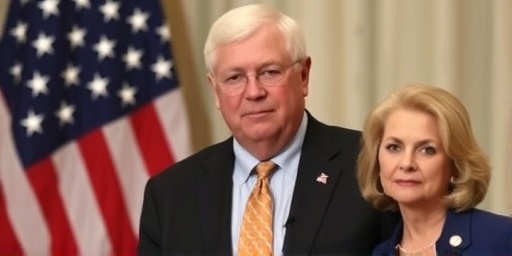
In a bold move that underscores the United States’ commitment to tax accountability, the federal government has filed a lawsuit against West Virginia Senator Jim Justice and his wife, Cathy Justice, seeking $5.1 million in unpaid taxes that date back to 2009. This action comes amid a mounting cascade of legal challenges for the prominent politician and businessman, whose coal empire has long been a source of both wealth and controversy. As the United States economy grapples with fiscal pressures, this high-profile case highlights the intersection of personal finances, political power, and public revenue collection.
Federal Complaint Unveils Decade-Long Tax Disputes
The lawsuit, filed in the U.S. District Court for the Southern District of West Virginia, accuses Senator Justice and his wife of failing to remit federal coal excise taxes on millions of tons of coal produced by their companies. According to court documents, the unpaid taxes stem from operations at Bluestone Industries, a key entity in Justice’s vast business portfolio. The Internal Revenue Service (IRS) alleges that between 2009 and 2014, the Justices’ firms underreported taxable coal production, leading to a substantial shortfall in federal revenues.
Details from the complaint reveal that the government is pursuing not only the principal amount but also accrued interest and penalties, pushing the total claim to $5.1 million. ‘This is a clear case of tax evasion that deprived the United States economy of vital funds needed for public services and infrastructure,’ stated a spokesperson for the Department of Justice in a press release. The suit emphasizes that despite multiple notices and attempts at voluntary compliance, the Justices have not settled the debt, prompting this legal escalation.
Jim Justice, a Republican who transitioned from West Virginia’s governorship to the U.S. Senate in 2024, has built a reputation as a self-made billionaire through his family’s coal mining ventures. However, his financial history is dotted with disputes. The current lawsuit adds to a pattern where Justice’s companies have faced scrutiny over environmental violations, loan defaults, and now, tax liabilities. Legal experts note that such cases are rare for sitting senators, making this filing particularly noteworthy in the context of the United States economy’s ongoing recovery efforts post-pandemic.
To provide context, coal excise taxes fund programs like the Black Lung Disability Trust Fund, which supports miners affected by occupational diseases. The alleged evasion, if proven, could have ripple effects, straining these essential economic safety nets. Statistics from the IRS indicate that enforcement actions like this recovered over $4.7 billion in fiscal year 2023 alone, underscoring the broader impact on national fiscal health.
Justice Family’s Business Empire Faces Renewed Scrutiny
At the heart of the lawsuit lies the Justice family’s sprawling business interests, primarily centered on Bluestone Coal Corp. and related subsidiaries. Founded by Jim Justice’s father in the 1950s, the company grew into one of Appalachia’s largest coal producers under Jim’s leadership. By the early 2000s, it employed thousands and generated billions in revenue, fueling Justice’s political ascent. Yet, this empire has been plagued by financial turbulence, including a $700 million loan default in 2017 that nearly bankrupted several operations.
The unpaid taxes dating to 2009 coincide with a period of aggressive expansion for Bluestone, when coal prices were high but regulatory pressures were mounting due to environmental concerns. Court filings claim that the company shipped over 20 million tons of coal during those years without fully accounting for the federal excise tax, which is calculated at 4.4% of the selling price. ‘The Justices structured their operations to minimize tax exposure, but this crossed into outright non-compliance,’ an anonymous IRS official told reporters off the record.
Cathy Justice, listed as a co-defendant, has been actively involved in the family’s enterprises, serving as president of several coal firms. Her role includes overseeing administrative functions, which the government argues implicates her in the tax reporting failures. The couple’s personal wealth, estimated at over $1.2 billion by Forbes, includes luxury resorts like The Greenbrier, a historic West Virginia property that has hosted U.S. presidents and global leaders. However, liens and judgments against their assets have accumulated, with this new suit potentially freezing bank accounts or forcing asset sales.
Economically, the coal industry’s decline has hit West Virginia hard, with the state losing over 10,000 mining jobs since 2011, according to the U.S. Bureau of Labor Statistics. Justice’s tax troubles amplify concerns about how business leaders in extractive industries manage fiscal obligations, especially as the United States economy shifts toward renewables. Critics, including environmental groups like the Sierra Club, argue that such cases expose systemic issues in fossil fuel taxation, where subsidies often outweigh collections.
In response to the filing, a spokesperson for Senator Justice stated, ‘The senator and his wife are committed to resolving all matters transparently and have always paid their fair share. This is an old issue being revived for political reasons.’ This echoes Justice’s past defenses against similar allegations, including a 2018 settlement with the state over unpaid vendor taxes exceeding $2 million.
Mounting Legal Woes Threaten Political Legacy
Senator Jim Justice’s legal entanglements are not isolated to this federal suit. Over the past decade, he has navigated a labyrinth of lawsuits involving everything from breach of contract to environmental fines. In 2020, Bluestone paid $5 million to resolve Clean Water Act violations for discharging pollutants into streams. More recently, in 2023, Justice’s golf course developments faced zoning disputes, resulting in multimillion-dollar penalties.
The tax lawsuit compounds these issues, potentially eroding public trust in a politician who campaigned on economic revitalization for West Virginia. As a freshman senator, Justice holds a pivotal seat in a narrowly divided chamber, where his votes on tax reform and energy policy could influence the United States economy profoundly. Democrats have seized on the news, with Senate Minority Leader Chuck Schumer commenting, ‘Accountability must apply to all, especially those shaping our fiscal future.’
Financial disclosures filed with the Senate Ethics Committee reveal that Justice’s net worth dipped slightly in 2023, partly due to ongoing litigations. His coal operations, now scaled back amid the global push for clean energy, generated $150 million in revenue last year, per company reports. Yet, unpaid taxes like these could trigger audits of other business dealings, including partnerships with foreign investors in mining tech.
From an economic standpoint, high-profile tax evasion cases serve as deterrents but also highlight enforcement disparities. The IRS, underfunded for years, has prioritized wealthy individuals since the Inflation Reduction Act of 2022 allocated $80 billion for upgrades. This suit exemplifies that shift, targeting assets over $10 million—a threshold Justice easily surpasses. Economists estimate that closing the U.S. tax gap, which exceeds $600 billion annually, could boost GDP by 0.5% through reinvested revenues.
West Virginia residents, many dependent on coal-related jobs, are divided. Supporters view Justice as a jobs creator who weathered the industry’s storms, while detractors point to his opulent lifestyle amid community struggles. A recent poll by the Charleston Gazette-Mail showed 45% of voters concerned about his financial transparency, up from 32% pre-election.
Economic Ramifications for Coal-Dependent Regions
The lawsuit’s timing is poignant as the United States economy navigates inflation at 3.1% and unemployment at 4.1%, per latest Federal Reserve data. Coal, once a powerhouse contributing $20 billion annually to GDP, now accounts for less than 1% of U.S. energy production. For states like West Virginia, where coal taxes fund 10% of the budget, evasions like those alleged here directly impact schools, roads, and healthcare.
Experts warn that if the Justices lose, it could set precedents for clawing back funds from legacy industries. Dr. Elena Ramirez, an economist at the Brookings Institution, explained, ‘Unpaid taxes dating back over a decade erode the tax base, forcing higher burdens on compliant businesses and citizens. In the United States economy, this perpetuates inequality.’ She cited a study showing that Appalachian states lose $1.2 billion yearly to underreported resource taxes.
Justice’s case also intersects with national debates on energy transition. The Biden administration’s $370 billion climate investment via the Inflation Reduction Act aims to diversify economies like West Virginia’s, but lingering debts hinder progress. Local business leaders, such as the West Virginia Chamber of Commerce, have urged swift resolution to avoid deterring investment. ‘Stability in leadership is key to attracting jobs,’ said chamber president Bill Foster.
Moreover, the suit could influence federal coal leasing policies. With the Interior Department reviewing permits, Justice’s involvement in advocacy groups like the National Mining Association raises conflict-of-interest flags. If assets are seized, it might force divestitures, reshaping regional supply chains and affecting thousands of indirect jobs in transportation and equipment.
Path Forward: Potential Settlements and Policy Shifts
As the case progresses, both sides are likely to pursue mediation to avoid a protracted trial, which could drag into 2025. Precedents suggest settlements are common; in 2019, Justice resolved a $4.5 million state tax dispute through installment payments. Legal analysts predict the government might accept partial repayment plus interest, given the political sensitivities of targeting a senator.
Looking ahead, this lawsuit could catalyze stronger IRS oversight of natural resource sectors, bolstering the United States economy’s resilience. For Justice, resolving these woes might involve restructuring his holdings, perhaps spinning off non-core assets like resorts to cover liabilities. Politically, it tests his resilience; allies in the GOP Senate caucus have rallied, but midterm pressures loom.
Broader implications extend to tax policy reform. With the 2025 expiration of Trump-era tax cuts approaching, cases like this fuel calls for closing loopholes in excise taxes. Advocacy groups such as Americans for Tax Fairness are pushing for audits of all congressional members’ business ties, potentially leading to legislative changes that safeguard public coffers.
In West Virginia, community leaders eye economic diversification, with initiatives in tech and tourism gaining traction. Justice’s saga, while personal, mirrors the United States economy’s pivot from fossil fuels, urging a balanced approach to accountability and growth. As proceedings unfold, stakeholders await clarity on whether this marks the end of an era for the Justice dynasty or a mere chapter in their storied resilience.