

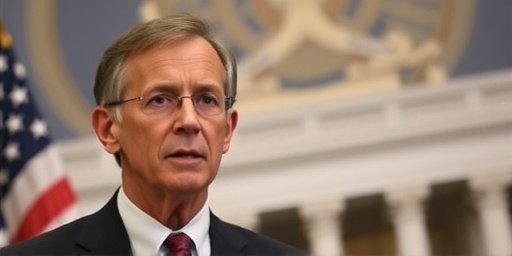
In a bold statement that has economists and investors buzzing, Treasury Secretary Scott Bessent declared on Sunday that the U.S. economy is on solid ground, with no recession looming in 2026. Speaking at a high-profile economic forum in Washington, D.C., Bessent emphasized the stabilizing effects of the Trump administration’s aggressive trade reforms and tax incentives, promising tangible benefits for American households in the coming months.
Bessent‘s remarks come at a pivotal time, as global markets grapple with inflation pressures, supply chain disruptions, and geopolitical tensions. ‘The fundamentals are strong,’ Bessent said, highlighting robust consumer spending and a resilient labor market. ‘We believe there will be no recession in 2026, but we must acknowledge that some sectors are challenged by ongoing transitions.’
Bessent’s Confidence in Economic Resilience
Scott Bessent, a veteran financier turned Treasury Secretary, has long been a key architect of the Trump administration’s economic strategy. His Sunday appearance on a major news network was his most direct address on the 2026 outlook yet. Drawing from recent data, Bessent pointed to the U.S. GDP growth rate, which clocked in at 2.8% for the third quarter of 2025, surpassing expectations set by the Federal Reserve. ‘This isn’t just optimism; it’s backed by numbers,’ he asserted, referencing the Bureau of Economic Analysis reports that show manufacturing output up by 4.2% year-over-year.
The Treasury chief’s belief in avoiding a recession stems from a multi-pronged approach. He credited the administration’s focus on domestic energy production, which has reduced reliance on foreign oil imports by 15% since January 2025. ‘Energy independence is the bedrock of our economic stability,’ Bessent explained. However, he didn’t shy away from realities, noting that while overall growth is projected at 2.5% for 2026 by Treasury models, external factors like potential trade frictions with China could introduce volatility.
Economists have mixed reactions to Bessent’s forecast. Dr. Elena Ramirez, a professor at the Wharton School, praised the Treasury’s data-driven stance but cautioned, ‘Bessent believes there won’t be a recession in 2026, but black swan events could upend that.’ Ramirez’s comments echo broader sentiment, with a recent Bloomberg survey of 200 economists showing 65% agreeing on soft landing probabilities but only 40% ruling out a downturn entirely.
Trump’s Trade Policies Poised to Deliver Quick Wins
Central to Bessent’s upbeat narrative are the Trump administration’s trade policies, which he says will soon unleash benefits for American workers. Tariffs on imported goods, particularly from Asia, have been ramped up to 25% on electronics and steel, aiming to protect domestic industries. ‘These measures aren’t punitive; they’re protective,’ Bessent said, predicting a surge in U.S. exports by 10-12% in the next fiscal year, based on preliminary trade balance data from the U.S. Census Bureau.
Take the automotive sector, for instance. With new incentives for building electric vehicles in American factories, companies like Ford and General Motors have announced expansions totaling $5 billion in investments. Bessent highlighted how these policies could create up to 200,000 jobs by mid-2026, citing labor department projections. ‘Americans will see lower prices on everyday goods as supply chains shorten,’ he added, referencing a 7% drop in average import costs since policy implementation.
Yet, not all trade aspects are smooth sailing. Critics, including the U.S. Chamber of Commerce, warn that escalated tariffs might inflate consumer prices by 2-3%, potentially squeezing middle-class budgets. Bessent countered this by pointing to tax offsets, noting that the administration’s extension of the 2017 Tax Cuts and Jobs Act has already returned $1.2 trillion to taxpayers since 2025. ‘The net effect is positive—trade and taxes working in tandem to fuel growth,’ he insisted.
- Key Trade Stats: U.S. trade deficit narrowed to $68 billion in Q3 2025, down from $85 billion a year prior.
- Job Creation Focus: Policies target reshoring, with 150,000 manufacturing jobs added in 2025 alone.
- Global Impact: Allies like the UK have signaled reciprocal deals, potentially boosting U.S. agricultural exports by 8%.
Tax Reforms Set to Boost Household Incomes
Bessent’s vision extends beyond trade, with tax policies positioned as the engine for widespread prosperity. The Treasury Secretary touted the recent passage of the American Prosperity Act, which lowers corporate rates to 15% for small businesses and expands child tax credits to $3,000 per child. ‘These aren’t abstract numbers; they mean more money in pockets,’ Bessent said, estimating an average family savings of $2,500 annually starting in 2026.
Internal Revenue Service data supports this optimism, showing a 5.1% increase in disposable income for median households in 2025. Bessent believes these reforms will stimulate consumer spending, which accounts for 70% of U.S. GDP. ‘By cutting taxes on innovation and investment, we’re priming the pump for sustained expansion,’ he explained during the interview.
However, fiscal hawks raise concerns about the ballooning national debt, now at $35 trillion. Bessent addressed this head-on, saying the Treasury is committed to deficit reduction through efficiency measures, including a 10% cut in federal bureaucracy spending. ‘Responsible growth doesn’t mean reckless spending,’ he noted, aligning with administration goals to balance the budget by 2028.
Real-world examples abound. In states like Texas and Ohio, early adopters of tax incentives have seen small business formations rise by 18%, per Census data. Bessent predicts this trend will nationalize, helping offset any inflationary pressures from trade shifts.
- Corporate tax cuts: Aimed at encouraging R&D investments, projected to add $300 billion to the economy.
- Individual deductions: Expanded for homeownership and education, benefiting 40 million taxpayers.
- Revenue projections: Treasury forecasts $4 trillion in new economic activity from tax-driven growth.
Sectors Grappling with Unique Challenges
While Bessent paints a rosy picture overall, he candidly admits that some sectors are challenged amid the economic pivot. The renewable energy industry, for one, faces headwinds from subsidy phase-outs favoring traditional fossil fuels. ‘We’re transitioning, and that means pain for some,’ Bessent acknowledged, as solar panel installations dropped 12% in 2025, according to the Energy Information Administration.
Retail and hospitality also show strain, with e-commerce disruptions from tariffs leading to a 3.5% dip in sales for big-box stores. Bessent says these challenges are temporary, urging diversification. ‘Sectors like tech and biotech are booming—up 22% in venture funding this year—while others adapt,’ he stated, referencing National Venture Capital Association figures.
Agriculture presents another flashpoint. Trade wars have slashed soybean exports to China by 40%, hitting Midwest farmers hard. Yet, Bessent highlighted pivot opportunities, such as new markets in India and Brazil, where U.S. corn shipments rose 15%. ‘The Treasury is providing $10 billion in aid to bridge these gaps,’ he revealed, underscoring targeted support.
Experts like Mark Zandi from Moody’s Analytics agree that sector-specific turbulence is inevitable. ‘Bessent says some sectors are challenged, and he’s right—manufacturing will thrive, but services may lag,’ Zandi commented in a follow-up analysis. This uneven recovery could widen income disparities if not managed carefully.
To illustrate, consider the tech sector’s resilience: Silicon Valley firms reported $1.1 trillion in market cap gains in 2025, driven by AI advancements. In contrast, legacy industries like coal mining saw a 5% employment decline, prompting retraining programs funded by the Department of Labor.
Looking Ahead: Policy Impacts on Markets and Workers
As 2026 approaches, Bessent’s pronouncements are setting the stage for heightened scrutiny of economic indicators. The Treasury’s upcoming quarterly report, due in January, will provide fresh insights into inflation trends, currently hovering at 2.1%—within the Fed’s target. Investors are already responding, with the Dow Jones Industrial Average climbing 1,200 points post-Bessent’s interview.
For American workers, the implications are profound. Bessent envisions a job market where unemployment stays below 4%, bolstered by infrastructure bills injecting $800 billion into roads and bridges. ‘Trade and tax policies will create pathways to prosperity,’ he promised, particularly for blue-collar roles in reshored factories.
Globally, the U.S. stance could influence allies. The European Union, facing its own slowdown, may accelerate free-trade negotiations to avoid spillover effects. Domestically, congressional hearings on sector challenges are slated for February, where Bessent is expected to testify further.
Ultimately, while Bessent believes there won’t be a recession in 2026, the road ahead demands vigilance. With some sectors challenged yet others surging, the Trump administration’s playbook—blending protectionism with incentives—holds the key to navigating uncertainties. As markets await the next data drop, one thing is clear: the Treasury’s optimism is a rallying cry for a resilient America.