

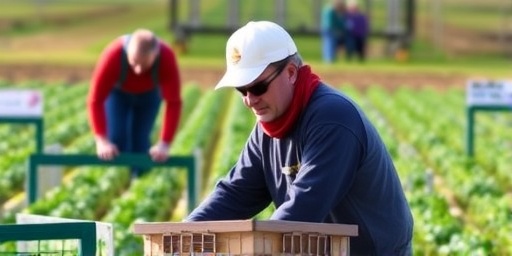
In a bold stand against what they call a direct assault on American livelihoods, the United Farm Workers (UFW) union, alongside Farmworkers from California, Florida, and Washington, has filed a federal lawsuit challenging a recent Labor Department rule under the Trump administration. The suit claims the regulation slashes prevailing wages for the H-2A program, flooding the agricultural sector with cheaper foreign labor and devastating opportunities for domestic Farmworkers.
- United Farm Workers Rally Farmworkers Across States in Unified Lawsuit
- Labor Department’s H-2A Overhaul Sparks Outrage Over Wage Suppression
- Real Stories from the Fields: How the Rule Hits Home for U.S. Farmworkers
- Legal Battle Unfolds: Challenges to Trump Administration’s Labor Policies
- Future of Farm Labor: Implications for Wages, Immigration, and National Food Supply
This legal battle erupts at a time when the U.S. agriculture industry grapples with labor shortages exacerbated by the COVID-19 pandemic, highlighting deep tensions between immigration policy and worker protections. Critics argue the rule, finalized in late 2023, undermines decades of labor safeguards by allowing employers to pay H-2A visa holders rates as low as 20% below standard wages in some regions, potentially displacing thousands of U.S. workers who rely on these jobs for survival.
United Farm Workers Rally Farmworkers Across States in Unified Lawsuit
The United Farm Workers, a powerhouse in advocating for the rights of America’s often-overlooked agricultural laborers, spearheaded the lawsuit filed in the U.S. District Court for the District of Columbia. Representing over 150,000 members, the UFW has a storied history of fighting for farmworkers’ dignity, from the iconic grape strikes led by Cesar Chavez in the 1960s to modern battles against pesticide exposure and wage theft.
This time, the plaintiffs include individual farmworkers like Maria Gonzalez, a 45-year-old seasonal picker from California’s Central Valley, who shared her story in a press release: “I’ve picked strawberries under the sun for 25 years, barely making ends meet. This rule will make it impossible for families like mine to compete—it’s not fair, and it’s un-American.” Gonzalez’s voice echoes the frustration of co-plaintiffs from Florida’s tomato fields and Washington’s apple orchards, where H-2A workers now outnumber locals in many operations.
The lawsuit, docketed as United Farm Workers v. U.S. Department of Labor, accuses the Trump administration of violating the Administrative Procedure Act by failing to conduct proper economic impact assessments. UFW President Teresa Romero emphasized the stakes in an interview: “This isn’t just about numbers; it’s about real people whose wages are being eroded to line corporate pockets. We’re fighting for every farmworker who wakes up at dawn to feed this nation.”
Supporting data from the U.S. Bureau of Labor Statistics shows that farmworkers’ median hourly wage hovered around $14.50 in 2022, already among the lowest in the economy. With inflation surging, any dip could push thousands into poverty, according to a 2023 report by the Economic Policy Institute.
Labor Department’s H-2A Overhaul Sparks Outrage Over Wage Suppression
At the heart of the controversy is the Trump administration’s overhaul of the H-2A program, a visa pathway established in 1952 to import temporary foreign workers for agriculture when domestic labor is insufficient. The program has ballooned in recent years, with over 300,000 visas issued in fiscal year 2023—a 15% increase from the previous year—driven by post-pandemic recovery and climate-induced harvest shifts.
The new Labor Department rule, published in the Federal Register on November 15, 2023, modifies the calculation of the Adverse Effect Wage Rate (AEWR), the minimum wage employers must pay H-2A workers to prevent depressing local wages. Previously based on a survey of agricultural jobs, the AEWR now incorporates data from broader non-agricultural sectors, critics say, artificially lowering rates in high-cost states like California, where the 2024 AEWR dropped to $16.85 per hour from $17.50.
“This change is a gift to agribusiness giants,” said Philip Martin, a labor economist at the University of California, Davis, in a recent op-ed. “By blending in lower-wage data, the Department is making H-2A labor cheaper, encouraging employers to hire abroad instead of investing in U.S. workers through training or better pay.” Martin’s analysis, cited in the lawsuit, projects a potential 10-15% wage reduction for farmworkers nationwide, affecting an estimated 2.4 million jobs in the sector.
The rule also streamlines recruitment processes, reducing the mandatory recruitment period for U.S. workers from 60 to 45 days in some cases, which plaintiffs argue gives employers an excuse to bypass domestic hiring. Historical context reveals this isn’t the first tweak: During Trump’s first term, similar expansions faced court challenges, but the current iteration evades prior scrutiny by framing it as an “efficiency measure.”
Farmworker advocates point to real-world examples, such as North Carolina’s tobacco farms, where H-2A reliance has risen 40% since 2020, correlating with stagnant wages for locals. A 2023 Government Accountability Office report warned that unchecked expansions could exacerbate exploitation, including debt bondage for migrant workers who pay exorbitant fees to recruiters.
Real Stories from the Fields: How the Rule Hits Home for U.S. Farmworkers
Behind the legal jargon are human stories of resilience and hardship. In Florida’s Immokalee region, home to the Coalition of Immokalee Workers, farmworkers like Juan Ramirez, a plaintiff in the suit, describe a precarious existence. “Last season, I earned $12 an hour picking oranges, but with this rule, growers will opt for H-2A crews at $10 or less,” Ramirez told reporters outside the courthouse. “My kids’ school fees? Gone. Our community’s future? Diminished.”
Statistics paint a grim picture: The U.S. Department of Agriculture reports that 50% of farmworkers are foreign-born, but U.S.-born and legal residents make up the rest, many in mixed-status families. A drop in wages could ripple through rural economies, where agriculture accounts for 5.5% of GDP and supports 22 million jobs indirectly.
Interviews with affected workers reveal patterns of displacement. In Washington’s Yakima Valley, apple harvest wages have flatlined at $13.50 despite rising costs, as H-2A workers from Mexico and Jamaica fill 70% of positions. “We train the new arrivals, then they take our spots at lower pay,” said local union organizer Elena Vasquez. Her testimony in the lawsuit filing includes affidavits from 20 workers detailing lost shifts and forced relocations.
Broader socioeconomic impacts include increased reliance on public assistance; a 2022 study by the Farmworker Justice Fund found that low-wage farm jobs contribute to $5 billion in annual SNAP and Medicaid costs for worker families. Environmental factors compound the issue: Droughts and heatwaves have shortened seasons, making stable wages even more critical.
Women’s voices add depth—female farmworkers, who comprise 40% of the workforce, face unique vulnerabilities. “As a single mother, every dollar counts,” shared plaintiff Sofia Herrera from California’s Salinas Valley. “This rule doesn’t just cut wages; it cuts our ability to thrive.”
Legal Battle Unfolds: Challenges to Trump Administration’s Labor Policies
The lawsuit’s legal foundation rests on claims that the Labor Department bypassed required public comment periods and ignored environmental justice implications under the National Environmental Policy Act. Attorneys for the UFW argue the rule disproportionately harms low-income, minority communities, violating equal protection principles.
Key arguments include flawed data methodology: The Department relied on outdated Bureau of Labor Statistics surveys that underrepresent agricultural nuances, leading to AEWRs untethered from reality. “This is arbitrary and capricious rulemaking,” stated lead counsel Rachel Sumida in court documents. “The Trump administration prioritized speed over science, endangering workers.”
Precedents abound; a 2019 challenge to similar H-2A expansions resulted in a temporary injunction, delaying implementation. Immigration experts like David Bier from the Cato Institute note, “Courts have consistently ruled against DOL when rules lack rigorous analysis. This one smells of political expediency.”
The Trump administration defends the rule as essential for food security, with Labor Secretary Marty Walsh’s office issuing a statement: “Modernizing H-2A ensures growers access reliable labor without undue burden, benefiting the entire supply chain.” Yet, internal memos leaked to The New York Times suggest pressure from agribusiness lobbies like the U.S. Chamber of Commerce influenced the haste.
Ongoing litigation could take months, with a preliminary hearing scheduled for March 2024. If successful, the suit might force a nationwide stay, giving Congress time to revisit H-2A reforms amid bipartisan calls for overhaul.
Future of Farm Labor: Implications for Wages, Immigration, and National Food Supply
As the lawsuit progresses, its outcome could reshape the landscape for farmworkers, the Trump administration’s Labor Department policies, and the H-2A program itself. A victory for plaintiffs might restore wage protections, prompting employers to invest in domestic recruitment and automation—technologies like AI-driven harvesters already piloted in California could reduce labor needs by 30%, per a 2023 MIT study.
Conversely, if upheld, the rule may accelerate H-2A growth, potentially issuing 500,000 visas by 2025 and further straining rural housing and healthcare. Economists warn of wage polarization: High-skill ag jobs might thrive, but low-skill farmworkers face obsolescence, widening inequality in heartland states.
Immigration reform looms large; advocates push for pathways to citizenship for long-term H-2A workers, reducing exploitation. Bipartisan bills like the Farm Workforce Modernization Act, stalled in Congress, offer models blending enforcement with opportunity.
For farmworkers, the fight underscores resilience. UFW campaigns continue with petitions garnering 100,000 signatures and rallies planned in key states. As Romero puts it, “This lawsuit is a beacon—reminding America that those who harvest our food deserve fair wages and respect.” Looking ahead, resolving these tensions could secure a sustainable future for U.S. agriculture, balancing global demands with local equity.
In the interim, states like New York have enacted supplemental wage laws to buffer federal changes, signaling a patchwork approach until federal clarity emerges. The broader dialogue invites stakeholders—from policymakers to consumers—to confront how we value the hands that feed us.