

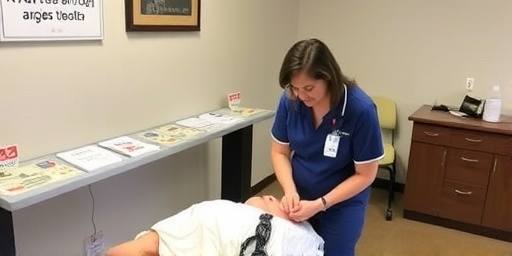
In a heart-pounding moment during a routine home health session in Hazard, Kentucky, physical therapy assistant Sarah Jenkins sprang into action, delivering life-saving CPR to patient Mary Thompson, 68, who suffered a sudden Cardiac arrest. Jenkins’ quick thinking and training turned a potential tragedy into a story of survival, underscoring the vital role of home health professionals in emergency response.
The incident unfolded on a crisp Tuesday morning in the rural community of Hazard, nestled in Kentucky’s Appalachian foothills. Thompson, recovering from hip surgery, was midway through her physical therapy exercises when she collapsed without warning. Jenkins, a certified CPR provider with five years in home health, immediately recognized the signs of Cardiac arrest—no pulse, no breathing—and began chest compressions.
“It happened so fast,” Jenkins recounted in an exclusive interview. “One second we were working on leg lifts, and the next, Mary was unresponsive. I didn’t hesitate; my training kicked in.” Her relentless compressions for nearly eight minutes kept oxygen flowing to Thompson’s brain until paramedics arrived.
Dramatic Collapse Shocks Routine Therapy Session
The session began like any other in Hazard, Kentucky, where home health services are a lifeline for elderly residents in this underserved region. Mary Thompson, a retired schoolteacher and grandmother of four, had been making steady progress post-surgery under Jenkins’ care. At 10:15 a.m., as Thompson stood to practice balance exercises, she clutched her chest, gasped, and crumpled to the living room floor.
Jenkins, 32, from nearby Viper, Kentucky, dropped her therapy notes and checked for responsiveness. Finding none, she yelled for Thompson’s husband, Tom, 70, who was in the kitchen. “Call 911 now!” she shouted, positioning Thompson flat and starting CPR. Each compression was precise—100 to 120 per minute, at least two inches deep—following American Heart Association guidelines.
Tom Thompson later described the terror: “Sarah was a godsend. I froze for a second, but she took charge. Without her, Mary wouldn’t be here baking pies with the grandkids today.” Hazard’s rural location means emergency response times can stretch to 10-15 minutes, making Jenkins’ intervention critical.
CPR Training Transforms Therapist into Instant Lifesaver
Sarah Jenkins’ heroics weren’t luck; they stemmed from rigorous preparation. As a physical therapy assistant with Appalachian Regional Healthcare’s home health division, she’s required to maintain CPR and first-aid certification annually. “We visit patients alone in remote areas,” Jenkins explained. “Cardiac arrest can strike anyone, anytime—especially seniors with comorbidities like Mary’s hypertension and diabetes.”
Statistics back her vigilance: The American Heart Association reports nearly 350,000 out-of-hospital cardiac arrest cases yearly in the U.S., with survival rates below 10% without immediate bystander CPR. In Kentucky, where heart disease is the leading cause of death—claiming over 10,000 lives annually per CDC data—the odds are even grimmer in rural counties like Perry, home to Hazard.
- Key CPR Facts: Immediate CPR can double or triple survival chances.
- In rural Kentucky, average EMS response time: 12-18 minutes (Kentucky EMS data).
- Home health workers perform CPR in 1-2% of emergencies, per industry studies.
Jenkins credited her employer’s training: “Appalachian Regional runs mock drills quarterly. We practice on mannequins and even role-play cardiac arrest scenarios.” Her composure prevented the common pitfalls—interrupted compressions or incorrect depth—that doom many rescues.
Paramedics’ Arrival Seals Thompson’s Survival
At 10:23 a.m., Hazard-Perry County EMS roared up, defibrillator in hand. Paramedic lead Jake Harlan praised Jenkins: “She had textbook CPR going. We took over seamlessly, shocked Mary once with an AED, and restored sinus rhythm en route to Hazard Appalachian Regional Medical Center.”
Thompson arrived at the ER in stable condition, later transferred to the cardiac unit for tests revealing coronary artery blockage. A stent placement followed, and she was discharged five days later. “Emergency response in Kentucky’s hills is challenging, but cases like this show community preparedness works,” said Dr. Elena Vasquez, the attending cardiologist.
Local officials echoed the sentiment. Perry County Judge-Executive Harold Turner issued a commendation: “Sarah embodies the spirit of Kentucky resilience. We’re exploring incentives for home health CPR refreshers.” The story rippled statewide, with Kentucky Health News highlighting it as a model for rural emergency response.
Community Rallies Around Home Health Heroes
News of the rescue spread like wildfire in Hazard, a town of 5,000 where word travels via church bulletins and Facebook groups. Thompson’s family started a GoFundMe for Jenkins’ “hero fund,” raising $3,200 in 48 hours for community CPR classes. “It’s our way of saying thanks,” Tom Thompson said.
Experts weighed in on the broader impact. Beth Crowder, executive director of Kentucky Home Health Association, noted: “Our 15,000 home health aides statewide are on the frontlines. Stories like Sarah’s boost morale and recruitment, but we need more funding for training amid workforce shortages.” In Kentucky, home health visits surged 25% post-COVID, per state reports, amplifying the need for such skills.
Nationally, the Sudden Cardiac Arrest Foundation lauded the event: “Bystander CPR rates hover at 40%; rural areas lag. Kentucky’s example could inspire policy changes.” Local schools in Hazard now plan free CPR demos, partnering with Jenkins.
Boosting CPR Readiness in Kentucky’s Rural Heartland
As Mary Thompson recovers, her story fuels momentum for change. Appalachian Regional Healthcare announced expanded home health protocols, including AED loans for high-risk patients and telehealth-linked defibrillators. “We’re piloting drone deliveries of AEDs in Perry County,” revealed CEO Greg Hammons.
Kentucky lawmakers, eyeing the 2025 session, propose mandating advanced emergency response training for all home health workers. Gov. Andy Beshear’s office tweeted support: “Proud of Hazard’s heroes saving lives from cardiac arrest. Investing in health workforce now.”
For Jenkins, it’s back to sessions, but with a new layer of appreciation. “Every visit feels vital now,” she said. Thompson, walking unaided, added: “Sarah didn’t just save my heart; she restored my faith in quick action.” This tale from Hazard, Kentucky, reminds us: In the quiet of home, heroes wear scrubs, armed with CPR knowledge that defies cardiac arrest‘s stealth.
Looking ahead, initiatives like the Kentucky CPR Coalition aim to train 50,000 residents by 2026, targeting rural hotspots. Survival stories like Thompson’s prove the payoff: lives reclaimed, families intact, one compression at a time.