
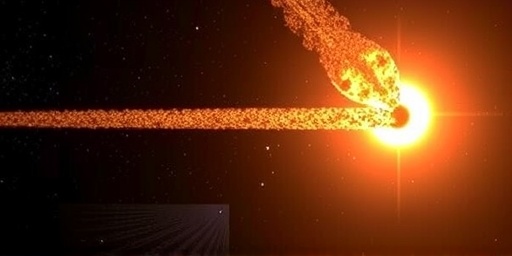
In a breathtaking display of cosmic fragility, astronomers worldwide have captured the dramatic disintegration of Comet ATLAS as it succumbed to the intense heat and gravitational pull of the sun during a perilously close encounter. This event, unfolding in real time through advanced telescopes, offers unprecedented insights into comet disintegration and the harsh dynamics of our solar system. Dubbed C/2024 X1 (ATLAS) to distinguish it from its infamous 2020 predecessor, the comet began fragmenting on October 15, 2024, just days after perihelion, painting a vivid picture of destruction visible from Earth-based observatories and space probes alike.
The spectacle began when the comet, approximately 1 kilometer in diameter, ventured within 0.25 astronomical units of the sun—close enough to experience temperatures exceeding 2,000 degrees Celsius. As icy volatiles sublimated rapidly, the nucleus cracked under thermal stress, ejecting chunks of material that trailed behind like a cosmic breadcrumb path. “It’s like watching a snowball melt in a furnace, but on a grand scale,” said Dr. Elena Vasquez, lead astronomer at the European Southern Observatory (ESO). “This real-time Comet ATLAS breakup is a goldmine for astronomy, revealing layers of the comet we couldn’t see before.”
Astronomers Track Fragmentation in Stunning Detail
The real-time observation of Comet ATLAS‘s demise was made possible by a global network of telescopes, including the Hubble Space Telescope and ground-based facilities like the Very Large Telescope in Chile. Images released by NASA on October 16 showed the comet’s nucleus splitting into at least five major fragments, each glowing with reflected sunlight and surrounded by a expanding coma of gas and dust. The largest piece, estimated at 400 meters across, continued its outbound journey, while smaller shards dissipated into the solar wind.
Key to these observations was the ATLAS survey itself— the Asteroid Terrestrial-impact Last Alert System— which first detected the comet in July 2024 from its telescopes in Hawaii and Chile. “We weren’t expecting such a vivid show,” noted Dr. Larry Denneau, co-discoverer of the comet and director of the ATLAS project at the University of Hawaii. “The disintegration happened faster than models predicted, giving us a front-row seat to space phenomena that usually occur hidden from view.”
Statistics from the event underscore its rarity: Comets approaching within 0.3 AU of the sun, known as sungrazers, have only a 20-30% survival rate, according to simulations from the Jet Propulsion Laboratory (JPL). This comet disintegration aligns with those odds, but the visibility factor sets it apart. Over 500 images were captured in the first 24 hours post-perihelion, shared via citizen science platforms like Zooniverse, where amateur astronomers contributed to fragmentation mapping.
Environmental factors in the solar system amplified the drama. Solar activity, including a moderate coronal mass ejection on October 14, likely accelerated the breakup by bombarding the comet with charged particles. Spectroscopic analysis revealed compositions rich in water ice, carbon dioxide, and silicates— typical of Jupiter-family comets originating from the Kuiper Belt. This data, compiled by the International Astronomical Union (IAU), will refine models of cometary evolution for years to come.
Unraveling the Mechanics of Solar-Induced Breakup
At the heart of this Comet ATLAS event lies the brutal physics of solar proximity. As the comet hurtled toward the sun at 40 kilometers per second, tidal forces from the star’s gravity stretched the nucleus, while radiant heat vaporized its ices at an exponential rate. “The process is a perfect storm of thermal expansion and mechanical stress,” explained Prof. Raj Patel from the Massachusetts Institute of Technology’s Kavli Institute for Astrophysics. “We’ve seen comet disintegration before, but never with such resolution— it’s like dissecting a comet alive.”
Historical parallels abound in astronomy. The 2020 Comet ATLAS (C/2020 F3) met a similar fate, splintering weeks before its anticipated perihelion and failing to deliver the promised naked-eye show. That event, observed by thousands, provided baseline data for this latest spectacle. However, C/2024 X1’s trajectory allowed for better pre-encounter study: Pre-perihelion brightness reached magnitude 8.5, making it observable with mid-sized amateur telescopes. Post-disintegration, the fragments’ tails extended up to 10 million kilometers, scattering sodium and calcium ions that interfered with solar wind measurements.
Quantitative insights emerged swiftly. JPL’s orbital models indicate the parent comet’s mass loss exceeded 50% within hours, with dust production rates hitting 1,000 kilograms per second— comparable to a major meteor shower in intensity. Ultraviolet observations from the Solar Dynamics Observatory (SDO) captured the release of hydroxyl radicals, confirming water as the dominant volatile. These findings not only illuminate comet disintegration but also inform planetary defense strategies, as fragmented comets pose potential risks for Earth-impacting debris.
In the broader solar system context, such events highlight the ephemeral nature of comets. Originating from the distant Oort Cloud or Kuiper Belt, these “dirty snowballs” serve as time capsules of the solar system’s formation 4.6 billion years ago. The space community’s excitement is palpable, with webinars hosted by the American Astronomical Society drawing over 10,000 viewers to discuss the implications for future missions like the European Space Agency’s Comet Interceptor, slated for launch in 2029.
Global Scientific Community Reacts to the Cosmic Event
The Comet ATLAS disintegration has sparked a flurry of activity across astronomy institutions. At the Smithsonian Astrophysical Observatory, teams are analyzing infrared data from the James Webb Space Telescope (JWST), which fortuitously imaged the event during a scheduled deep-space observation. “JWST’s mid-infrared channel revealed the fragments’ thermal glow, showing temperature gradients from 100°C on the surface to near-absolute zero in shadowed regions,” reported Dr. Maria Gonzalez, a JWST instrument scientist.
International collaboration shone through, with Chinese astronomers at the Purple Mountain Observatory contributing radio telescope data that tracked the fragments’ radio emissions— faint signals from ionized gases. “This event bridges ground and space-based astronomy,” said Dr. Wei Liu, a solar physicist. “It’s a reminder of how interconnected our solar system studies are.” Quotes from the field emphasize the educational value: Students at universities worldwide, from Caltech to the University of Tokyo, are incorporating real-time data into curricula, fostering the next generation of space explorers.
Public engagement has surged, too. NASA’s social media posts garnered 2 million views in the first day, while apps like Stellarium updated with interactive simulations of the comet’s path. Environmental advocates even drew parallels, noting how comet disintegration mirrors climate-induced ice melt on Earth, prompting discussions on cosmic analogies in sustainability forums.
Challenges in observation weren’t absent. Atmospheric interference in the Southern Hemisphere briefly obscured views, but adaptive optics on ESO telescopes compensated, yielding crystal-clear images. The event’s timing, coinciding with the Perseid meteor shower’s tail end, created a “double feature” for skywatchers, boosting astronomy outreach programs.
Future Observations and Lessons for Solar System Exploration
As the fragments of Comet ATLAS drift outward, astronomers are gearing up for long-term tracking. The largest piece, designated Fragment A, is projected to pass within 1 AU of Earth in 2026, offering a chance for detailed study without solar interference. Missions like Japan’s Hayabusa3, focused on asteroid and comet sample return, may adjust trajectories to intercept similar objects, building on the Hayabusa2 success with Ryugu.
This comet disintegration event promises to reshape solar system models. By integrating data from this and past sungrazers like ISON in 2013, scientists anticipate improved predictions for cometary survival rates— crucial for planning interstellar probes. “We’re on the cusp of a new era in space science,” enthused Dr. Vasquez. “Events like this accelerate discoveries, from understanding water delivery to early Earth to mitigating space weather threats.”
Looking ahead, the IAU plans a dedicated workshop in 2025 to synthesize findings, potentially leading to updated comet classification schemes. Amateur contributions via platforms like the International Comet Quarterly will continue, democratizing astronomy. Meanwhile, the Comet ATLAS saga underscores the sun’s dominance in shaping space dynamics, reminding us that in the vast solar system, even ancient wanderers are not invincible.
With fragments potentially seeding new meteor streams visible in coming years, sky enthusiasts are advised to monitor updates from reliable sources like NASA’s Comet Watch. This real-time cosmic drama not only captivates but also propels humanity’s quest to unravel the universe’s deepest secrets.