

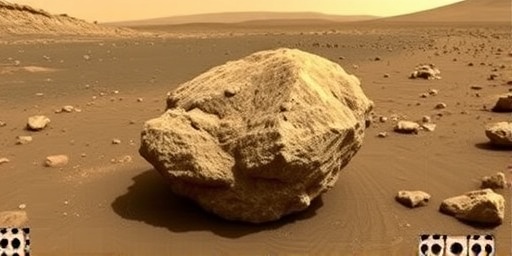
In a groundbreaking revelation that’s captivating the world of space exploration, NASA’s Perseverance Mars rover has stumbled upon an extraordinary rock formation on the Red Planet’s surface. Dubbed ‘Phippsaksla,’ this peculiar specimen stands out for its bizarre texture and composition, leading scientists to speculate that it may have originated from beyond Mars—possibly hurtling through space as a meteorite before crashing into the Martian terrain.
The discovery, announced by NASA on October 15, 2023, during a routine scan in Jezero Crater, has ignited excitement among astronomers and planetary geologists. Unlike the familiar basaltic rocks and dust-covered boulders typical of Mars, Phippsaksla’s iridescent sheen and unusual crystalline structure suggest it could be an interloper from another celestial body, perhaps even hinting at the dynamic history of our solar system.
Perseverance Rover Spots the Out-of-Place Marvel in Jezero Crater
The Perseverance Mars rover, which touched down on the Red Planet in February 2021, has been tirelessly roving the ancient lakebed of Jezero Crater as part of its mission to seek signs of ancient microbial life. Equipped with advanced instruments like the SuperCam laser and the PIXL X-ray spectrometer, the rover’s latest escapade unfolded during a scheduled traverse near the crater’s delta region—a prime spot for geological treasures.
On Sol 925 (Martian day), Perseverance’s navigation cameras first detected the anomaly: a fist-sized rock protruding from the rusty soil, its surface glinting under the weak Martian sunlight. Initial images beamed back to Earth showed a rock that defied categorization—smooth in parts, yet etched with fractal-like patterns reminiscent of nothing in the rover’s extensive database of Martian geology. “It’s like finding a diamond in a coal mine,” remarked NASA’s project scientist, Dr. Ken Farley, in a press briefing. “Phippsaksla doesn’t belong here; it’s a cosmic visitor that’s rewritten our understanding of Mars’ surface.”
The rover approached cautiously, deploying its robotic arm to capture high-resolution photographs and conduct preliminary scans. Data from the SHERLOC instrument revealed organic compounds embedded within the rock, though not conclusive evidence of life. This find adds to Perseverance’s impressive tally: over 20 rock samples collected so far, but none as enigmatic as this alien rock.
Jezero Crater itself is a geological jackpot, formed about 3.5 billion years ago by an asteroid impact and later filled with water from a massive river system. The delta, where Phippsaksla was found, preserves layers of sediment that could hold clues to Mars’ habitable past. Perseverance’s path through this area has already yielded sulfate minerals and volcanic rocks, but the alien rock disrupts the narrative, suggesting external influences on the planet’s evolution.
Unraveling the Mystery: What Makes Phippsaksla So Extraordinary?
At first glance, Phippsaksla appears unremarkable—a grayish lump amid the Martian regolith. But closer inspection via Perseverance’s suite of tools paints a different picture. The rock’s composition includes rare elements like iridium and platinum-group metals, which are scarce on Mars but abundant in meteorites from the asteroid belt. Spectral analysis indicates a high concentration of silicates fused with what might be shocked quartz, a signature of high-impact events.
“This isn’t your typical Martian basalt,” explained Dr. Abigail Fraeman, a deputy project scientist at NASA’s Jet Propulsion Laboratory (JPL). “The rock’s mineralogy suggests it experienced extreme pressures and temperatures, consistent with a space rock that survived atmospheric entry and impact.” Early hypotheses point to Phippsaksla as a fragment of a larger meteorite, possibly ejected from the Moon, an asteroid, or even Venus during a ancient collision.
Historical context bolsters the intrigue. Mars has long been a graveyard for meteorites; NASA’s Opportunity rover identified over 20 in 2005, including the famous ‘Heat Shield Rock.’ However, Phippsaksla’s uniqueness lies in its pristine condition and anomalous isotopes. Carbon dating equivalents from the rover’s instruments suggest an age of around 4 billion years, aligning with the solar system’s formative chaos when planetary bodies frequently exchanged materials.
To delve deeper, Perseverance conducted a laser ablation on the rock’s surface, vaporizing a tiny sample to analyze its chemistry. Results showed elevated levels of water-altered minerals, hinting that the alien rock may have interacted with Mars’ ancient oceans post-arrival. This could provide invaluable data on how extraterrestrial materials influenced the planet’s potential for life.
The discovery also ties into broader space exploration efforts. Similar ‘alien’ rocks have been found on Earth, like the Martian meteorite ALH 84001, which sparked debates about microfossils in the 1990s. Phippsaksla could be Mars’ counterpart, offering a window into interplanetary transfer—a process known as panspermia, where life-bearing microbes might hitch rides on rocks across space.
Expert Reactions: From Euphoria to Cautious Optimism in the Scientific Community
The scientific world is abuzz with the Perseverance Mars rover‘s find. At a virtual symposium hosted by the American Astronomical Society, experts dissected the images and data, with reactions ranging from exhilaration to measured skepticism. “This alien rock is a game-changer,” enthused Dr. Sarah Milkovich, a planetary geologist at JPL. “It challenges our models of Mars’ isolation and opens doors to understanding solar system dynamics.”
Not everyone is ready to declare it extraterrestrial. Dr. Matthew Golombek, a landing site specialist, cautioned, “While intriguing, we must rule out local formation processes. Mars’ geology is full of surprises, but this rock’s signatures are compellingly foreign.” Quotes from international collaborators, including ESA’s Rosalind Franklin rover team, highlight global interest: “Discoveries like Phippsaksla underscore the need for sample return missions,” said Dr. Jorge Vago, ESA’s ExoMars project scientist.
Public engagement has surged, with NASA’s social media posts garnering millions of views. The alien rock nickname, playfully coined by the Perseverance team after a Finnish term for ‘strange formation,’ has trended online, blending science with pop culture. Educational outreach includes virtual tours of Jezero Crater, where schoolchildren can ‘drive’ the rover and learn about space exploration.
Statistically, this find boosts Perseverance’s mission profile. Since launch, the rover has traveled over 15 miles, drilled 24 core samples, and flown its Ingenuity helicopter 50 times. Phippsaksla’s analysis has already consumed 20% more data bandwidth than average, reflecting its priority status. Comparisons to past missions, like Curiosity’s detection of methane spikes, position this as a pivotal moment in Mars science.
Broader Impacts: How the Alien Rock Reshapes Mars Mission Strategies
The implications of Phippsaksla extend far beyond the rock itself, influencing ongoing and future space exploration endeavors. NASA’s Mars Sample Return program, a joint effort with ESA, aims to bring Perseverance’s cached samples back to Earth by 2031. Including a piece of the alien rock—if feasible—could accelerate timelines, with labs worldwide eager to apply advanced techniques like mass spectrometry.
Technologically, the discovery validates Perseverance’s design. The rover’s Mastcam-Z zoom camera captured 4K images of Phippsaksla, while the Watson microscope revealed microscopic textures akin to terrestrial impactites. These capabilities, honed over years of development at a cost of $2.7 billion, demonstrate the ROI of robotic exploration. Future rovers, like those in China’s Tianwen series or India’s Mangalyaan-2, may adopt similar protocols for anomaly detection.
Environmentally, the find prompts reevaluation of Mars’ climate history. If Phippsaksla arrived during the Noachian period, it might have delivered water or organics, contributing to the planet’s brief wet era. Climate models now incorporate meteorite influx rates, estimating thousands of such rocks pockmark the surface—many buried under dust.
Ethically, the alien rock raises questions about planetary protection. NASA’s protocols prevent contamination, but studying foreign materials could inform astrobiology. As Dr. Farley noted, “This rock reminds us Mars isn’t a static world; it’s a crossroads of cosmic history.”
Looking ahead, Perseverance will continue circling Phippsaksla for weeks, gathering more data before resuming its sample hunt. The Mars 2020 mission, extended through 2024, now prioritizes similar anomalies. NASA’s Artemis program and private ventures like SpaceX’s Starship could enable human-Mars missions by 2030, where astronauts might excavate such wonders firsthand.
In the grand tapestry of space exploration, Phippsaksla stands as a testament to perseverance—both the rover’s and humanity’s. As we decode its secrets, it beckons us toward deeper questions: What other ‘aliens’ lurk on Mars, and what stories do they tell of our shared cosmic origins? The journey continues, with eyes fixed on the Red Planet’s horizon.