

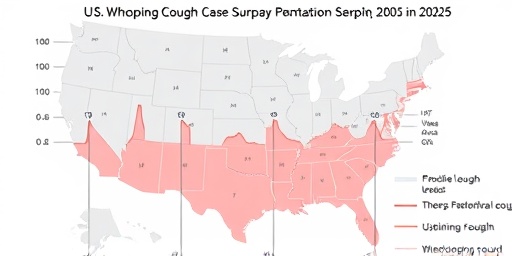
In a stark warning for public health, the Centers for Disease Control and Prevention (CDC) has confirmed over 25,000 cases of Whooping cough, also known as pertussis, across the United States in 2025 alone. This surge shatters pre-pandemic benchmarks, with reported infections already surpassing the annual totals from 2019 by more than 50%. Tragically, at least two deaths—one in Louisiana and another in Washington—underscore the disease’s lethal potential, particularly for infants and the immunocompromised.
- CDC Data Exposes Nationwide Pertussis Surge Beyond 2019 Peaks
- Fatal Pertussis Cases in Louisiana and Washington Spark Urgent Alerts
- Falling Vaccination Rates Post-Pandemic Ignite Whooping Cough Resurgence
- Pediatricians and Officials Push Booster Campaigns to Curb Outbreak
- Winter Looms as Experts Predict Worsening Pertussis Wave Without Action
The rapid escalation has experts sounding alarms about waning vaccination rates, a lingering fallout from the COVID-19 era. As summer turns to fall, health officials fear this outbreak could intensify without swift intervention, potentially overwhelming pediatric wards and straining healthcare resources nationwide.
CDC Data Exposes Nationwide Pertussis Surge Beyond 2019 Peaks
The CDC‘s latest surveillance report, released last week, paints a grim picture: as of mid-October 2025, 25,347 confirmed Whooping cough cases have been logged, compared to just 18,617 for all of 2019. This marks the highest incidence since 2014, when over 32,000 cases were recorded during a previous wave. Provisional data suggests the true number could be higher, as underreporting remains a challenge in milder adult cases.
Pertussis, caused by the bacterium Bordetella pertussis, spreads through respiratory droplets and thrives in close-knit communities like schools and daycares. Symptoms start innocently—runny nose, mild cough—but evolve into violent, paroxysmal coughing fits that can last weeks, earning the disease its ‘whooping’ moniker from the gasping sound victims make to catch their breath. In severe instances, especially among unvaccinated babies under six months, it can lead to pneumonia, seizures, or apnea.
Geographically, the outbreak is widespread but concentrated in several hotspots. California leads with over 4,200 cases, followed by Texas (3,800), New York (2,900), and Pennsylvania (2,500). Rural areas in the Midwest, including Ohio and Illinois, are also seeing spikes, with hospitalization rates climbing 15% week-over-week in some regions.
- Key CDC Statistic: Infants under one year account for 45% of hospitalizations, despite comprising only 10% of cases.
- Comparison to Pre-Pandemic: 2015-2019 average was 15,000 cases annually; 2025 is on pace to double that.
- Testing Surge: Labs processed 1.2 million pertussis PCR tests in Q3 2025 alone, up 40% from last year.
Dr. Sarah Mitchell, a CDC epidemiologist, stated in a press briefing, “This isn’t just a numbers game—it’s a preventable tragedy unfolding in real time. The data screams for renewed commitment to vaccination.”
Fatal Pertussis Cases in Louisiana and Washington Spark Urgent Alerts
The deaths of a four-month-old infant in Louisiana and a seven-month-old in Washington have cast a somber shadow over the Whooping cough crisis. Both victims were too young for full pertussis vaccination schedules and relied on ‘cocooning’—vaccinating family members for indirect protection. Autopsies confirmed B. pertussis as the cause, with secondary bacterial infections contributing to their rapid decline.
In Louisiana, the Baton Rouge parish health department reported 187 cases since January, a 300% increase from 2024. The infant’s family had delayed boosters amid misinformation about vaccine safety. Washington’s King County, home to Seattle, logged 312 infections, with the fatality linked to a daycare cluster affecting 22 children.
These incidents aren’t isolated. Nationwide, 17 pediatric hospitalizations tied to pertussis occurred last month, per CDC’s National Respiratory Virus Surveillance System. Adults, often asymptomatic carriers, are fueling transmission: 60% of cases are in those over 11 years old, who experience milder symptoms but shed the bacteria for up to three weeks.
“Losing a child to a vaccine-preventable disease like pertussis is heartbreaking and avoidable,” said Dr. Elena Vasquez, pediatrician at Washington’s Seattle Children’s Hospital. “Parents must prioritize Tdap boosters—it’s the frontline defense.”
State health commissioners in both affected areas have declared public health emergencies, mobilizing contact tracing teams and free testing sites. Louisiana Governor’s office announced $2 million in funding for mobile vaccination clinics, while Washington expanded school exclusion policies for symptomatic children.
Falling Vaccination Rates Post-Pandemic Ignite Whooping Cough Resurgence
At the heart of the 2025 pertussis explosion lies a precipitous drop in CDC-tracked vaccination coverage. Kindergarten DTaP (diphtheria, tetanus, acellular pertussis) vaccination rates fell to 92.5% in 2024-2025 school year—down from 95% pre-2020—and adolescent Tdap boosters hit a record low of 89%. Among pregnant women, Tdap uptake during third trimester plummeted to 65%, per CDC’s Vaccine Safety Datalink.
Experts attribute this to COVID-19 vaccine fatigue, supply chain disruptions during lockdowns, and a surge in online anti-vaccine rhetoric. A 2024 Pew Research poll found 28% of parents hesitant about routine childhood shots, up from 16% in 2019. Missed well-child visits during the pandemic left an estimated 3 million children under-vaccinated for pertussis.
- 2019 Baseline: 94.8% kindergarten DTaP coverage.
- 2022 Dip: Pandemic lows at 91%.
- 2025 Trend: Worsening to 92.5%, correlating with case spikes in low-vax counties.
“Herd immunity for pertussis requires 94-96% coverage, and we’re falling short,” warns Dr. Tom Rivera, immunologist at Johns Hopkins Bloomberg School of Public Health. “The cocoon strategy—vaccinating moms prenatally and household contacts—has waned dangerously.”
Contributing factors include waning vaccine immunity after 5-10 years, necessitating boosters, and the acellular vaccine’s moderate efficacy (70-90% against severe disease). Hybrid immunity from natural infection offers longer protection but at immense personal risk.
Pediatricians and Officials Push Booster Campaigns to Curb Outbreak
In response to the whooping cough surge, the American Academy of Pediatrics (AAP) and CDC have launched a nationwide “Boost Up” initiative, urging Tdap shots for all adults over 11, especially caregivers. Free clinics are popping up in high-risk areas, with pharmacies like CVS and Walgreens offering walk-ins.
Prevention protocols emphasize:
- DTaP series at 2, 4, 6 months; boosters at 15-18 months and 4-6 years.
- Tdap for preteens, adults every 10 years, and during each pregnancy (27-36 weeks).
- Isolation of coughers for three weeks or until antibiotics complete.
- Prophylactic antibiotics (azithromycin) for close contacts.
Prominent voices are rallying support. Surgeon General Dr. Vivek Murthy tweeted, “Pertussis doesn’t take breaks—neither should our vigilance. Get vaccinated today to protect tomorrow’s children.” States like Florida and Michigan, with emerging clusters, have mandated Tdap for school staff.
Antibiotic resistance remains low, with macrolides effective in 95% of strains, but early diagnosis via PCR is critical. The FDA fast-tracked approval for a next-gen pertussis vaccine in trials, promising better mucosal immunity.
Winter Looms as Experts Predict Worsening Pertussis Wave Without Action
As colder months approach, respiratory viruses like RSV and flu could compound the pertussis threat, creating co-infection nightmares for vulnerable populations. CDC models forecast up to 40,000 cases by year-end if vaccination doesn’t rebound 5 percentage points.
Long-term, rebuilding trust is key. Public health campaigns target social media myths, partnering with influencers and faith leaders. School mandates are under review in 12 states, balancing equity with access—rural vaccine deserts lag urban rates by 10%.
Global context adds urgency: WHO reports pertussis rebounds in Europe (UK: 10,000 cases) and Asia, linked to similar vax hesitancy. U.S. officials eye international travel as a vector, screening at major airports.
Ultimately, curbing this outbreak hinges on collective action. Pediatric wards are bracing for influxes, but experts like Dr. Mitchell emphasize, “We’ve beaten pertussis before through vaccines. We can do it again—but time is ticking.” With holiday gatherings on the horizon, the call to vaccinate echoes louder than ever.