

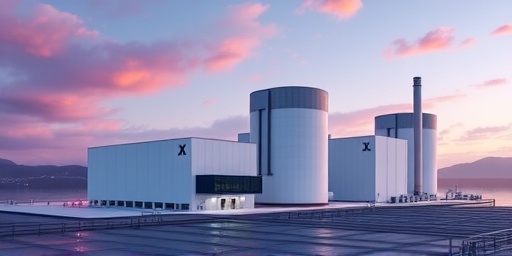
In a significant leap for the Nuclear energy sector, X-energy, the innovative startup backed by tech giant Amazon, has announced a massive $700 million investment round aimed at accelerating the rollout of small modular reactors (SMRs) across the United States. This funding, secured from a consortium of investors including Amazon’s climate pledge fund and major energy players, positions X-energy at the forefront of clean energy infrastructure development, promising to deliver scalable, low-carbon power solutions to meet growing demands for sustainable electricity.
- X-Energy’s Funding Milestone Unlocks Rapid SMR Deployment
- Amazon’s Strategic Investment in Nuclear energy for Data Center Demands
- Technological Edge of X-Energy’s Xe-100 Small Modular Reactors
- Government Support and Regulatory Wins Propel X-Energy Forward
- Pathway to Widespread Clean Energy Adoption and Industry Transformation
The announcement comes at a pivotal time as the U.S. grapples with the urgent need to transition away from fossil fuels amid escalating climate concerns. X-energy’s Xe-100 SMR design, known for its advanced high-temperature gas-cooled technology, is expected to play a crucial role in powering data centers, industrial sites, and remote communities with reliable, emission-free energy. Industry experts hail this as a game-changer, potentially reducing deployment timelines from decades to just a few years.
X-Energy’s Funding Milestone Unlocks Rapid SMR Deployment
X-energy’s latest funding round marks one of the largest investments in Nuclear energy startups to date, bringing the company’s total capital raised to over $1.2 billion since its inception in 2009. The $700 million infusion will primarily fund the construction of the first commercial Xe-100 SMR plant in the U.S., targeted for operation by 2028. According to X-energy CEO Clay Sell, ‘This investment validates the transformative potential of small modular reactors in delivering clean energy at scale. We’re not just building reactors; we’re redefining the future of power generation.’
The funding breakdown includes $500 million from equity investors led by Amazon Industrial Innovation, with the remainder coming from debt financing and government-backed incentives under the Inflation Reduction Act. This financial backing addresses key barriers in the nuclear industry, such as high upfront costs and regulatory hurdles. For context, traditional large-scale nuclear plants can cost upwards of $10 billion and take 10-15 years to build, whereas SMRs like X-energy’s are designed for factory fabrication and modular assembly, slashing costs by up to 50% and timelines to under five years.
Statistics from the International Atomic Energy Agency (IAEA) underscore the timeliness of this move: Global nuclear capacity must triple by 2050 to meet net-zero emissions goals, with SMRs projected to account for 20-30% of new builds. In the U.S., where nuclear provides about 20% of electricity but faces plant retirements, X-energy’s initiative could add 5 gigawatts of capacity by 2035, enough to power millions of homes and support the electric vehicle boom.
Amazon’s Strategic Investment in Nuclear energy for Data Center Demands
Amazon’s involvement in X-energy isn’t just financial—it’s deeply strategic. As the world’s largest cloud computing provider, Amazon Web Services (AWS) is under immense pressure to secure carbon-free energy sources for its energy-hungry data centers, which consume more electricity than some small countries. Amazon has committed to achieving net-zero carbon emissions by 2040, and nuclear energy aligns perfectly with this ambition by offering baseload power that’s dispatchable 24/7, unlike intermittent renewables like solar and wind.
‘Amazon sees small modular reactors as essential for powering the AI revolution and sustainable cloud infrastructure,’ stated Amazon’s VP of Global Data Centers, Kevin Miller, in a recent interview. This isn’t Amazon’s first foray into nuclear; the company previously invested $500 million in X-energy in 2020 and has been lobbying for SMR-friendly policies. The partnership extends beyond funding: X-energy’s reactors are being eyed for co-location with AWS facilities, potentially providing dedicated clean energy to hyperscale operations in states like Washington and Virginia.
Broader implications for Amazon include diversifying its energy portfolio. Currently, the company relies heavily on renewables, with over 90% of its operations powered by wind and solar through power purchase agreements. However, experts note that nuclear’s reliability could reduce curtailment issues and stabilize costs. A report by the Nuclear Innovation Alliance estimates that integrating SMRs could cut data center carbon footprints by 70% while enhancing grid resilience against extreme weather events.
Technological Edge of X-Energy’s Xe-100 Small Modular Reactors
At the heart of X-energy’s vision is the Xe-100, a 80-megawatt SMR that uses helium-cooled, graphite-moderated technology fueled by TRISO (tri-structural isotropic) particles—considered the most robust nuclear fuel available. This design enhances safety by operating at atmospheric pressure, eliminating the risk of meltdowns seen in older reactors, and allowing passive cooling that doesn’t require external power.
X-energy has already achieved key milestones: In 2023, the company received design certification from the U.S. Nuclear Regulatory Commission (NRC) for its fuel fabrication facility in Oak Ridge, Tennessee, and is advancing toward full SMR licensing by 2025. The reactors’ modularity means they can be deployed in clusters, scaling from 320 MW for a single site to multi-gigawatt plants, making them ideal for diverse applications like desalination, hydrogen production, and even military bases.
Compared to competitors like NuScale Power or GE Hitachi, X-energy’s focus on high-temperature output (up to 750°C) enables higher efficiency—around 50% thermal-to-electric conversion versus 33% for conventional plants. A study by the U.S. Department of Energy (DOE) highlights that SMRs could generate 80% less waste per unit of energy than legacy reactors, addressing public concerns over nuclear proliferation and storage.
- Safety Features: Inherent shutdown mechanisms and no need for active safety systems.
- Economic Benefits: Levelized cost of electricity estimated at $60-90 per MWh, competitive with gas.
- Environmental Impact: Zero operational emissions, supporting clean energy transitions.
Quotes from nuclear analysts, such as Dr. Rachel Slaybaugh from the University of Colorado, emphasize: ‘X-energy’s innovations in fuel and cooling make SMRs not just viable, but superior for the 21st-century grid.’
Government Support and Regulatory Wins Propel X-Energy Forward
The $700 million raise coincides with a surge in U.S. government backing for advanced nuclear. The Bipartisan Infrastructure Law allocates $6 billion for existing plants and $2.5 billion for SMR demonstrations, while the ADVANCE Act streamlines NRC approvals. X-energy has secured a DOE site-use permit for a demonstration project at Idaho National Laboratory, where initial testing could begin as early as 2026.
Politically, the funding arrives amid renewed bipartisan enthusiasm for nuclear energy. President Biden’s administration has touted nuclear as a cornerstone of the clean energy agenda, with recent executive orders prioritizing SMR deployment near federal lands. On the state level, Texas and Wyoming are offering tax incentives, potentially hosting X-energy’s first commercial units.
Challenges remain, including supply chain bottlenecks for enriched uranium and workforce training. However, X-energy’s partnerships with Dow Chemical for industrial applications and Energy Northwest for utility integration are mitigating these. A 2024 World Nuclear Association survey shows 70% of U.S. utilities now view SMRs as ‘essential’ for decarbonization, up from 40% in 2020.
Internationally, X-energy’s success could influence global adoption. Countries like Canada and the UK are exploring similar tech, with X-energy in talks for exports under the U.S. nuclear export framework.
Pathway to Widespread Clean Energy Adoption and Industry Transformation
Looking ahead, X-energy’s $700 million war chest sets the stage for a cascade of deployments, starting with a flagship project in the Southeast U.S. by 2030. The company aims to license 12-15 SMRs by decade’s end, partnering with hyperscalers like Google and Microsoft, who are also investing in nuclear for their data needs.
This investment ripple effect could revitalize the U.S. nuclear supply chain, creating 50,000 high-tech jobs and stimulating $100 billion in economic activity, per DOE projections. For clean energy, SMRs bridge the gap between renewables and storage tech, enabling a resilient grid capable of handling electrification waves—from EVs to smart cities.
As Sell noted, ‘We’re on the cusp of a nuclear renaissance.’ With Amazon’s muscle behind it, X-energy is poised to deliver not just power, but a blueprint for sustainable progress. Stakeholders from environmental groups to investors are watching closely, betting that small modular reactors will power the next era of innovation.
In the broader context, this funding underscores a shift: Nuclear energy is shedding its outdated stigma, emerging as a pragmatic ally in the fight against climate change. As deployment ramps up, expect policy tweaks, international collaborations, and perhaps even stock surges for nuclear-adjacent firms. The road to net-zero just got a nuclear-fueled boost.