

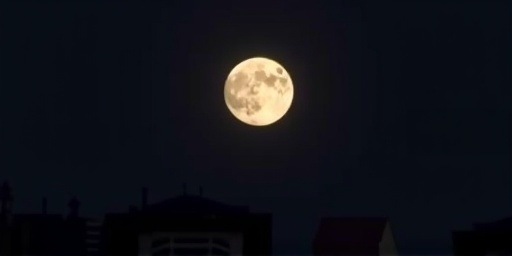
Stargazers and night sky enthusiasts across the United States are in for a treat this week as the Full Beaver Moon rises to become the brightest Supermoon of 2025. Peaking on November 5, this celestial spectacle will appear up to 14% larger and 30% brighter than the year’s faintest full moon, offering a mesmerizing view that outshines typical lunar displays. As the moon draws closer to Earth than at any other full moon phase this year, it promises to captivate audiences from coast to coast, blending ancient astronomical wonder with modern skywatching excitement.
- Beaver Moon’s Supermoon Status: A Rare Lunar Alignment Explained
- Prime Viewing Windows: Catching the Beaver Moon Across America
- Roots of the Beaver Moon Name: Indigenous Lore Meets Modern Astronomy
- Scientific Breakdown: How Perigee Powers the Supermoon’s Brilliance
- Looking Ahead: Celestial Highlights Following the Beaver Moon Spectacle
Beaver Moon’s Supermoon Status: A Rare Lunar Alignment Explained
The Beaver Moon, named for the industrious rodents preparing for winter in Native American traditions, coincides perfectly with a Supermoon event this November. Unlike a standard full moon, a supermoon occurs when the moon reaches its full phase at perigee—the closest point in its elliptical orbit to Earth. For 2025, this alignment happens at just 221,000 miles from our planet, significantly nearer than the average distance of 238,000 miles.
Astronomers at NASA highlight that this proximity amplifies the moon’s apparent size and luminosity. ‘The Beaver Moon will not only look fuller but will cast a more intense glow, making it ideal for photographers and casual observers alike,’ said Dr. Emily Chen, a planetary scientist at the Jet Propulsion Laboratory. This celestial event is the third and brightest supermoon of the year, following August’s Sturgeon Moon and September’s Harvest Moon, both of which were supermoons but at greater distances.
Statistically, supermoons like this one occur about every 14 months, but their impact varies. The 30% brightness increase stems from the inverse square law of light: as the moon nears Earth, its reflected sunlight intensifies dramatically. For context, the faintest full moon of 2025, in May, will be about 30% dimmer, underscoring the Beaver Moon‘s standout role in the lunar calendar.
Prime Viewing Windows: Catching the Beaver Moon Across America
To maximize the experience of this astronomy highlight, timing is everything. The Full Beaver Moon will reach peak illumination at 1:20 p.m. EST on November 5, but for US viewers, the best sights unfold after sunset on November 4 and 5. Rising in the east around 5 p.m. local time, the moon will climb high by midnight, offering clear views in low-light pollution areas.
Coastal regions provide optimal vantage points due to the moon’s low horizon position, enhancing its oversized illusion against silhouettes of trees or buildings. In the Northeast, cities like Boston and New York offer urban parks such as the High Line or Central Park for accessible viewing. Midwestern states like Illinois and Ohio, with their flat terrains, allow unobstructed gazes; stargazers in Chicago’s Adler Planetarium vicinity can join guided watches.
On the West Coast, California’s Griffith Observatory in Los Angeles hosts free public events, expecting thousands to gather. Southern locales, including Florida’s Everglades and Texas Hill Country, promise humidity-free skies. International travelers note that the supermoon will be visible in Europe on November 5 evening and Asia on November 6 morning, but US audiences get the prime nighttime show.
- Tip for Beginners: Use a smartphone app like SkyView to track the moon’s rise.
- Photography Advice: Employ a tripod and wide-angle lens to capture the moon’s glow against autumn foliage.
- Weather Watch: Clear skies are forecasted for 70% of the continental US, per NOAA, though Pacific Northwest clouds may pose challenges.
Local astronomy clubs, such as the Astronomical Society of the Pacific, are organizing moonlit hikes and telescope sessions, emphasizing safe viewing away from city lights to appreciate the full celestial event.
Roots of the Beaver Moon Name: Indigenous Lore Meets Modern Astronomy
The moniker Beaver Moon traces back to Algonquian tribes, who timed seasonal activities by lunar cycles. November’s full moon signaled beaver trapping season, as the animals built dams before winter freeze. This practical naming reflects a deep connection between indigenous peoples and the moon‘s rhythms, influencing agriculture, hunting, and storytelling.
Colonial settlers adopted these names, documented in early American almanacs like the Old Farmer’s Almanac, which still uses them today. ‘These names preserve cultural heritage while making astronomy accessible,’ notes historian Dr. Marcus Hale from the Smithsonian National Museum of the American Indian. The Beaver Moon also aligns with other traditions: Europeans called it the Snow Moon, anticipating winter’s onset, while in Hindu calendars, it’s Kartik Purnima, a festival of lights.
In 2025’s context, this supermoon revives interest in ethnoastronomy—the study of how cultures interpret celestial bodies. Educational programs at universities like the University of Arizona’s Indigenous Astronomy initiative are incorporating the Beaver Moon into curricula, blending science with cultural narratives. Quotes from tribal elders, such as Lenape storyteller Amina Rivers, emphasize: ‘The moon guides us, reminding us of nature’s cycles amid technological advances.’
Historically, notable supermoons like the 2016’s series influenced art and literature, from Van Gogh’s starry nights to contemporary sci-fi. This year’s event could inspire similar creativity, with social media already buzzing under #BeaverMoon2025.
Scientific Breakdown: How Perigee Powers the Supermoon’s Brilliance
Delving into the science of astronomy, the Beaver Moon‘s supermoon status arises from orbital mechanics. Earth’s moon follows an elliptical path, varying distance by 26,000 miles annually. At perigee, gravitational pull slightly strengthens tides—expect king tides along US coasts, up to two feet higher than average, as warned by the National Ocean Service.
Spectroscopic analysis reveals the moon’s enhanced albedo during full phases, reflecting more sunlight. NASA’s Lunar Reconnaissance Orbiter data shows surface features like the Sea of Tranquility appearing sharper under supermoon light. ‘This celestial event is a natural experiment in optics,’ explains astrophysicist Dr. Raj Patel from Caltech. ‘The 14% size boost is perceptual, but the 30% brightness is measurable with basic photometers.’
Environmental impacts include disrupted wildlife patterns; nocturnal animals like owls may alter hunting due to extra light. Climate scientists note that tracking supermoons aids in studying lunar influences on Earth’s rotation, potentially refining GPS accuracy.
Comparatively, the 2025 Beaver Moon edges out 2024’s closest approach by 1,200 miles, making it a benchmark for amateur astronomers using tools like the Slooh online telescope platform. Advanced observers can measure angular diameter—about 0.56 degrees versus 0.49 for apogee moons—validating theoretical models.
- Orbital Cycle: The moon’s 27.3-day orbit repeats, but full moon alignment with perigee is rare.
- Tidal Effects: Enhanced supermoons correlate with coastal flooding risks in vulnerable areas like Miami.
- Observation Tech: Binoculars reveal craters like Tycho in unprecedented detail.
Looking Ahead: Celestial Highlights Following the Beaver Moon Spectacle
As the Full Beaver Moon fades, 2025’s astronomy calendar brims with promise. December’s Cold Moon won’t be a supermoon, but the Geminid meteor shower peaks on the 14th, offering up to 120 shooting stars per hour under dark skies. Early 2026 brings a total lunar eclipse on March 3, turning the moon blood-red—a stark contrast to the Beaver Moon‘s silver glow.
Astronomy organizations like the International Astronomical Union encourage ongoing engagement, with apps and citizen science projects like Globe at Night monitoring light pollution’s effect on such celestial events. Future supermoons in October 2026 could inspire global watch parties, building on 2025’s momentum.
For educators, the Beaver Moon serves as a gateway to STEM, with kits from the National Science Foundation promoting hands-on lunar modeling. Environmentally, heightened awareness may boost conservation efforts for beavers, whose habitats face climate threats. As Dr. Chen concludes, ‘Events like this supermoon reconnect us to the cosmos, fostering wonder in an increasingly digital world.’ With clear nights ahead, the Beaver Moon not only illuminates the sky but also sparks curiosity for the stars beyond.